
University of Exeter Welcomes First Students to Joint Education Institute with ZJUT: What the UK’s Transnational Education Milestone Means for Prospective Students
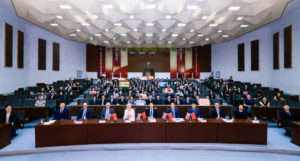
The University of Exeter has reached a defining moment in its international strategy. On 2 September, the university welcomed its inaugural cohort of undergraduate students to the Exeter-Zhejiang University of Technology (ZJUT) Joint Education Institute in China, marking Exeter’s first transnational education cohort and one of the most significant developments in UK-China academic cooperation in recent years.
For prospective students, parents, and education professionals watching the growth of UK transnational education, this launch offers a valuable case study in how a leading British university can bring its academic standards, research culture, and teaching expertise directly to students in another country. This article examines what the Joint Education Institute offers, why the Exeter-ZJUT partnership matters, and what students considering transnational education programmes should know before applying.
A Matriculation Ceremony That Signalled a Shared Ambition
The first day of term at the Joint Education Institute carried the weight of years of planning. A formal matriculation ceremony brought together students, academic leaders, and partners from both universities to celebrate the beginning of studies and the next chapter in a partnership that has been building for more than a decade.
Speakers at the ceremony included Professor Lisa Roberts, President and Vice-Chancellor of the University of Exeter; Professor CHEN Jiming, President of ZJUT; Professor LIU Yujing, Executive Vice-Dean of the Joint Education Institute; and Professor Tim Quine, the President’s Special Envoy and Vice-Dean for Academic Affairs. Their messages converged on a single theme: the students joining the Institute are not merely preparing for a changing world, they are being asked to shape it.
Professor Chen spoke about the profound transformations sweeping across society and industry, urging students to move beyond simply responding to change. The ceremony also featured a memorable tradition in the making: a time capsule event titled ‘A Letter to My Future Self,’ in which new students placed letters into a capsule that will be opened at their graduation ceremony. It is a small ritual with a powerful message about long-term commitment, both for the students and for the institution they have joined.
The message from Exeter’s leadership was equally clear. Professor Roberts described the Institute as a significant step in the university’s global ambitions, emphasising an educational environment that combines international perspectives, academic excellence, and real-world relevance. For students, this means a degree experience designed to prepare them for a rapidly evolving digital and technological landscape rather than a static curriculum.
What the Joint Education Institute Offers Students
Approved by China’s Ministry of Education in 2025, the Joint Education Institute combines the University of Exeter’s academic expertise with ZJUT’s strong industry connections. This pairing is deliberate. Exeter brings research-led teaching and the pedigree of a UK Russell Group university, while ZJUT contributes deep links to Chinese industry and an established record of producing technically skilled graduates.
The Institute delivers high-quality, research-led degree programmes in four disciplines:
- Engineering – with a curriculum oriented toward the technologies and problem-solving methods that modern industry demands.
- Data science – one of the most sought-after fields globally, reflecting the explosion of demand for professionals who can interpret and act on complex datasets.
- Information technology – covering the systems and infrastructure that underpin digital economies.
- Digital media – addressing the creative and technical dimensions of how content is produced, distributed, and experienced.
Once fully established, the Institute will provide degree programmes for up to 1,200 students within a dynamic UK-China academic framework. That scale matters: it signals a long-term institutional commitment rather than a pilot scheme, and it creates a substantial student community with the critical mass needed for societies, research projects, and peer networks.
A Curriculum Built for AI, Digital Innovation, and Sustainability
The Institute’s stated mission is to prepare future leaders for a world shaped by advances in artificial intelligence, digital innovation, and the transition to a more sustainable future. This framing has practical consequences for students. Courses are designed to connect academic theory with the challenges employers are actively trying to solve, from automation and machine intelligence to environmental responsibility in engineering and technology sectors.
Students at the Institute can expect a learning environment that treats these themes not as optional extras but as core to how the disciplines are taught. For anyone weighing up degree options in engineering or the data sciences, that orientation is worth paying attention to: graduates who can work confidently at the intersection of technology and sustainability tend to have broader career options.
Why the Exeter-ZJUT Partnership Runs Deeper Than a Single Launch
The Joint Education Institute did not appear overnight. It builds on more than a decade of successful collaboration between the University of Exeter and ZJUT, a track record that gives the new venture unusual stability. Partnerships of this kind succeed when both institutions have established trust, aligned academic standards, and a history of working together on research and student exchange. The Exeter-ZJUT relationship satisfies all three conditions.
Beyond teaching, the Institute is positioned as a hub for talent development, joint research, and industry engagement. This means students will study in an environment connected to active research collaborations and employer networks on both sides, not an isolated teaching campus. For undergraduates, access to research-active faculty and industry-linked projects can make a measurable difference to the quality of a degree and to post-graduation opportunities.
The partnership also creates opportunities that flow in both directions. Researchers and academic colleagues in the UK and China gain new avenues for collaboration, while students in each country benefit from curricula and perspectives informed by two distinct academic traditions. As transnational education grows across the UK higher education sector, the Exeter-ZJUT model, anchored in a long-standing bilateral relationship, offers a template worth studying.
What This Milestone Means for Transnational Education in the UK
Transnational education, in which a UK university delivers programmes to students located outside the UK, has become one of the fastest-expanding areas of British higher education. The arrival of the first students at the Exeter-ZJUT Joint Education Institute represents a landmark achievement in Exeter’s global education strategy and strengthens one of its most significant international partnerships.
For students weighing their options, the growth of transnational education changes the calculus of studying for a UK degree. Programmes like those at the Joint Education Institute allow students to earn a qualification shaped by UK academic standards without relocating to Britain, at a lower total cost, and while remaining close to home markets and family networks. At the same time, students gain exposure to British pedagogy, English-language academic conventions, and international faculty.
Quality assurance is the critical question in this sector, and it is here that the details matter. The Institute’s approval by China’s Ministry of Education provides regulatory oversight on the Chinese side, while the University of Exeter’s involvement ties the programmes to the academic governance of a UK institution. Prospective students evaluating any transnational programme should look for exactly this combination: recognition by the education ministry in the host country and direct academic accountability from the awarding UK university.
Practical Advice for Students Considering Transnational Education Programmes
If the launch of the Exeter-ZJUT Joint Education Institute prompts you to consider transnational education options, a few practical steps will help you make a well-informed decision:
- Verify approvals and accreditation. Confirm that the programme is officially recognised by the relevant education authorities in the host country and that the degree is awarded or co-awarded by the UK university itself.
- Examine the curriculum, not just the brand. Look at module descriptions, teaching methods, and assessment styles. Strong transnational programmes mirror the academic rigour of the home campus.
- Investigate industry connections. Programmes with genuine employer engagement, such as the industry links ZJUT contributes to this partnership, tend to produce better employment outcomes.
- Ask about progression pathways. Some transnational programmes offer opportunities to study at the UK campus for a semester or a year, or to progress to postgraduate study in the UK. Understanding these options early can shape your planning.
- Consider the student community. With capacity for up to 1,200 students, the Exeter-ZJUT Institute is being built as a full academic community. Campus culture, societies, and peer support all contribute significantly to the student experience.
The Institute’s shared vision, ‘We build the minds that build the future,’ is an apt summary of what students should look for in any transnational programme: an education that equips them to lead in fields undergoing rapid change, rather than one that simply credentials them in established knowledge.
A New Chapter for Students, Researchers, and Both Institutions
The first matriculation ceremony at the Exeter-ZJUT Joint Education Institute is more than a news item; it is the opening of a long-term educational project. For the inaugural cohort, it marks the start of degrees that will carry the combined strengths of a leading UK university and a technologically ambitious Chinese institution. For the wider higher education community, it demonstrates how transnational education can be built on genuine partnership rather than opportunistic expansion.
As the Institute grows toward its full capacity and its programmes mature, it will be worth watching how its graduates fare, how its research collaborations develop, and how it influences the next generation of UK-China academic partnerships. For now, the message to prospective students is straightforward: transnational education has entered a new phase, and the options available to ambitious students in engineering, data science, information technology, and digital media have never been broader.
Ready to take the next step? Explore the University of Exeter’s international programmes and learn more about study opportunities at the Exeter-ZJUT Joint Education Institute by visiting the university’s official study pages. Have questions about applications or entry requirements? Write to the admissions team directly, and share your thoughts or experiences with transnational education in the comments below.