
Rising Carbon Dioxide Levels Drive Savanna Grass Growth: University of Sheffield Research Reveals the Ecological Impact
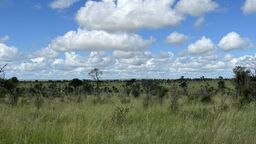
Rising carbon dioxide levels are quietly reshaping one of the largest ecosystems on Earth. A new study led by the University of Sheffield, UK, and published in Nature, shows that increasing atmospheric CO₂ is boosting savanna grass growth across Africa’s water-limited landscapes — a finding that overturns a long-standing scientific assumption and carries significant consequences for wildlife, fire regimes, and the global carbon cycle.
The scale of the evidence is striking. Researchers combined findings from 70 carbon dioxide experiments with a unique 32-year record of grass production gathered from 533 locations in South Africa’s Kruger National Park. The data revealed a 28 per cent increase in grass production between 1989 and 2021 — a trend that aligned most closely with rising carbon dioxide levels rather than any other environmental factor.
For students, researchers, conservation planners, and anyone tracking how climate change alters the natural world, the study demonstrates that rising carbon dioxide levels act as more than a warming agent. They directly change how plants grow, compete, and use water. Below, we break down what the research found, why the results surprised the scientific community, and what the ecological impact could mean for savannas worldwide. If you want to examine the evidence in detail, you can read the full study in Nature.
Why the Findings Challenge Decades of Scientific Assumptions
The grasses that dominate tropical and subtropical savannas belong to a group known as C₄ grasses. These plants use a specialised form of photosynthesis that performs exceptionally well under hot, high-light conditions — precisely the environment savannas provide. Because C₄ photosynthesis is already highly efficient at capturing carbon dioxide, scientists long assumed these grasses would gain little additional benefit as atmospheric CO₂ continued to rise.
The new research shows otherwise. According to Dr Kimberley Simpson, Research Fellow in the University of Sheffield’s School of Biosciences and the study’s lead author, higher carbon dioxide helps wild savanna grasses conserve water, reduce drought stress, and continue growing even under dry conditions.
“The grasses that dominate savannas have often been considered largely unresponsive to rising carbon dioxide because they already use a highly efficient form of photosynthesis under hot and high-light conditions,” Dr Simpson explained. “Our findings challenge that assumption.”
This distinction matters. If savanna grasses respond to carbon dioxide levels in ways scientists did not expect, then models predicting future vegetation patterns, fire behaviour, and carbon storage across half of Africa’s land surface may need to be revised.
How the Research Team Built the Evidence Base
One of the study’s greatest strengths lies in combining controlled experiments with long-term field observation. Neither approach alone would have been as convincing; together, they form a robust and persuasive case.
Insights From 70 Carbon Dioxide Experiments
The international research team, which included collaborators at Princeton University, analysed results from 70 experiments that manipulated carbon dioxide levels around growing plants. These experiments revealed a consistent pattern: when CO₂ increased, wild savanna grasses lost less water through their leaves, maintained photosynthesis for longer during dry spells, and produced more aboveground growth.
A 32-Year Record From Kruger National Park
Experiments answer the question of mechanism, but field data answer the question of scale. The team examined a 32-year record of grass production from 533 sites across Kruger National Park, one of Africa’s most closely monitored savanna landscapes. Between 1989 and 2021, grass production rose by 28 per cent.
Importantly, the researchers tested alternative explanations. They accounted for rainfall, temperature, grazing pressure, fire history, nitrogen pollution, and shifts in grass species composition. None of these factors fully explained the increase. The pattern instead matched the trajectory of rising atmospheric carbon dioxide — and the relative gains in grass growth were greatest in the park’s driest areas, exactly where the water-conserving effect of CO₂ should matter most.
“Finding the same pattern in controlled experiments and across more than three decades of observations in a natural savanna provides strong evidence that rising carbon dioxide has been changing these ecosystems for some time,” said Professor Colin Osborne, from the University of Sheffield’s School of Biosciences.
The Mechanism: Water Conservation Under Dry Conditions
Understanding why grasses respond this way helps clarify the wider ecological impact. Plants lose water through tiny pores on their leaves called stomata, which they open to absorb carbon dioxide. When atmospheric CO₂ is more abundant, plants can take in what they need while keeping these pores partly closed, reducing water loss.
In water-limited savannas, this advantage compounds across the growing season. Grasses exposed to higher CO₂ experience less drought stress, keep photosynthesising through dry periods that would otherwise stall growth, and accumulate more biomass above ground. The result is a measurable, system-wide increase in savanna grass growth driven directly by the composition of the atmosphere.
The Ecological Impact: Fire, Wildlife, and Carbon Storage
Increased grass growth may sound like good news, but the researchers caution that the consequences are complex and, in some cases, concerning. Savannas cover around a fifth of the Earth’s land surface and account for roughly 30 per cent of global plant productivity, so even modest changes ripple outward.
More Grass Means More Fuel for Fires
Savanna fires are a natural and ecologically important process, but fuel loads influence how often fires occur, how intensely they burn, and how far they spread. More grass biomass means more fuel, which could increase fire activity across affected landscapes. That, in turn, affects tree cover, animal habitats, and even regional air quality.
Shifting Forage and Wildlife Distribution
Greater grass production can provide more forage for grazing animals, from insects to antelope to livestock. Changes in food availability can redistribute wildlife across a landscape, altering predator-prey dynamics and creating new management challenges for national parks and pastoralist communities alike.
The Carbon Storage Question
Perhaps the most counterintuitive finding concerns the carbon cycle. Extra grass does not automatically translate into long-term carbon storage. “More grass does not automatically mean more carbon will be stored,” Dr Simpson noted. “The wider impact depends on where the extra grass ends up. If it is eaten by animals or burned in fires, much of the carbon is quickly released back into the atmosphere.”
Because savannas span such enormous areas, even small percentage changes in how much carbon they store — or release — carry global significance. Carbon accounting systems and climate models that treat savanna productivity as static may therefore underestimate future variability.
What Climate Models Project for the 21st Century
The study did not stop at documenting the past. Using climate model simulations, the team examined whether the CO₂-driven boost to savanna grass growth is likely to continue. The answer: yes, through much of the 21st century. Although the higher temperatures and reduced rainfall projected under future climate scenarios weakened the effect, they did not eliminate it.
This carries a practical implication for researchers and policymakers alike. When predicting the future of savanna ecosystems, the direct fertilising effect of rising carbon dioxide must be considered alongside changing temperatures and rainfall patterns. Models that focus only on climate variables risk overlooking a major driver of vegetation change that is already underway.
A Shifting Balance Among Grass Species
One of the study’s most intriguing results concerned plant communities themselves. Over the observation period, taller and more productive grass species became increasingly dominant in Kruger National Park. This shift explained part — but not all — of the increase in grass biomass, raising new questions about how rising carbon dioxide may reshape competition among savanna plants.
“Our next step is to understand whether rising carbon dioxide is changing not only how much grass grows, but also which species thrive,” said Professor Osborne. “Changes in competition between grasses could have important consequences for how savannas function in the future.”
If certain species gain an advantage under elevated CO₂, the composition of savanna plant communities could shift in ways that affect everything from soil dynamics to the animals that depend on particular grasses for food.
Why the Research Matters Beyond Africa
Although the study focused on Kruger National Park, its implications extend well beyond South Africa’s borders. Savannas cover half of Africa’s land surface and vast areas of South America, Australia, and Asia. The findings suggest that rising carbon dioxide levels may be altering grassland productivity across all of them.
For fire managers, the results point to the need to anticipate higher fuel loads. For conservation organisations, they highlight shifting forage patterns that could change where animals move. For climate scientists, they add a previously underweighted factor to models of the global carbon cycle. And for livestock keepers, increased grass production could change grazing dynamics in ways that are both ecologically and economically significant.
Researching Global Ecosystems at the University of Sheffield, UK
The study reflects the University of Sheffield’s broader research strengths in biosciences and environmental science. Work of this kind depends on long-term monitoring, international collaboration, and the ability to link laboratory-scale plant physiology to landscape-scale patterns — a combination the University’s School of Biosciences has cultivated across its research groups and cross-faculty centres of excellence.
For prospective students and early-career researchers, studies like this illustrate the kind of questions modern ecology now asks: not simply whether the climate is changing, but how specific atmospheric and climatic factors alter the behaviour of real ecosystems over decades. If that question interests you, explore the biosciences and ecology programmes at the University of Sheffield to see where a career in environmental science could lead.
Have questions about savanna ecology or ecosystem research? Write to us, or share your perspective in the comments below — particularly if you work in conservation, land management, or fire ecology and have observed similar trends.
Key Takeaways From the Study
- Rising carbon dioxide levels increase savanna grass growth. Grass production in Kruger National Park rose 28 per cent between 1989 and 2021, a trend consistent with rising CO₂ rather than rainfall, temperature, grazing, or fire.
- C₄ grasses are not immune to elevated CO₂. Higher carbon dioxide helps these grasses conserve water and sustain growth under dry conditions, challenging a long-standing assumption.
- The ecological impact is mixed. More grass can mean more fire fuel, redistributed wildlife, and uncertain effects on long-term carbon storage.
- The trend is expected to continue. Climate modelling suggests CO₂-driven growth increases could persist through the 21st century, even under hotter, drier conditions.
- Plant communities may reorganise. Taller, more productive grass species are becoming more dominant, hinting at broader shifts in savanna competition and function.
Final Thoughts
The University of Sheffield-led study is a reminder that climate change acts through more than heat. Rising carbon dioxide levels are directly reshaping how plants use water, how much they grow, and which species dominate — with consequences that extend from fire risk in Kruger National Park to the global carbon cycle. Understanding these effects requires exactly what this research delivered: long-term data, controlled experiments, and a willingness to question long-held assumptions.
If you found this analysis useful, explore our related articles on ecosystem science and climate research for further reading. To stay informed about new findings from environmental researchers in the UK and beyond, subscribe to our newsletter and receive updates as new studies are published.