
Building UK Technological Innovation: Loughborough University and the £400M INFINITY Advanced Tech Park
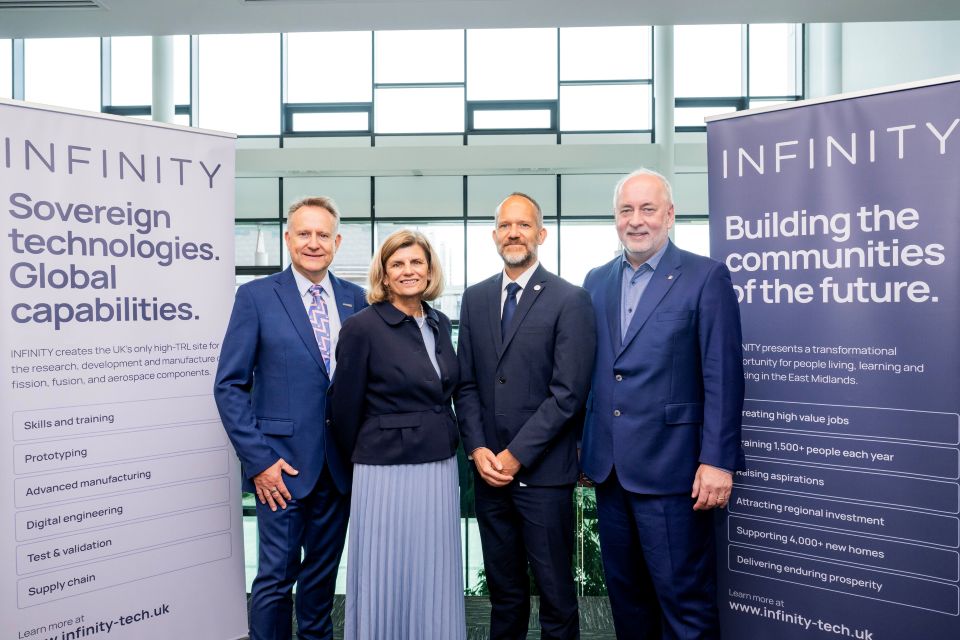
Loughborough University has taken a founding role in one of the UK’s most significant industrial developments of the decade. In September 2026, the university signed a joint venture agreement alongside the University of Derby, the Manufacturing Technology Centre (MTC), and Infinity Technology Group Ltd to deliver INFINITY, a £400 million advanced tech park planned for Derby. The agreement marks a decisive milestone, moving the project from concept into its investment and development stage.
The INFINITY project is designed to deliver the capability and capacity required by strategic UK programmes that power, defend, and mobilise the nation. Its technologies are expected to carry international significance, and its economic footprint will reach well beyond the East Midlands. For students, researchers, engineers, and business leaders with an interest in technological innovation, this development warrants close attention.
Considering a career in advanced manufacturing or engineering research? Explore undergraduate, postgraduate, and research degree opportunities at Loughborough University to see how its strengths connect directly to ambitious projects like INFINITY.
What Is the INFINITY Project and Why Does It Matter?
INFINITY is a planned 200-acre advanced technology park at Infinity Park Derby, situated within the East Midlands Investment Zone. The development will create highly specialised facilities for the research, development, and manufacture of essential components. Planned infrastructure links will support a host of buildings on site, all located close to the existing Nuclear Skills Academy.
The project arrives at a moment when governments worldwide treat industrial capability as a matter of national strategy. Supply chain resilience, clean energy technology, and defence-adjacent manufacturing have moved up the policy agenda, and the UK Government has identified advanced manufacturing as a priority sector. INFINITY aligns directly with these strategic objectives, offering the kind of capacity that supports UK sovereign programmes—the national capabilities underpinning energy, defence, and mobility.
The Four Founding Partners Behind the Advanced Tech Park
The joint venture combines four organisations with complementary strengths:
- Loughborough University contributes an international reputation for research that matters. Over 90% of its research was rated world-leading or internationally excellent in the Research Excellence Framework 2021, and the university ranks among the UK’s top ten institutions in the Complete University Guide 2027.
- The University of Derby brings deep regional roots and a commitment to social mobility, skills development, and collaboration with industry across the East Midlands.
- The Manufacturing Technology Centre offers world-class expertise in production methods and industrial application, bridging the distance between laboratory research and the factory floor.
- Infinity Technology Group Ltd, trading as INFINITY, serves as the delivery company for the project, led by Chief Executive Professor Gary Jones.
Leadership Appointments Signal Long-Term Commitment
As part of the agreement, Professor Dan Parsons, Pro Vice-Chancellor for Research and Innovation at Loughborough University, has been appointed as a director of Infinity Technology Group Ltd. He joins Professor Gary Jones, Gregg Smith, and Susan Ambler on the board, while James Fussell, University Secretary at the University of Derby, takes the role of Company Secretary. These appointments place senior academic and operational leaders directly accountable for delivering the project—an important signal of institutional commitment.
How Loughborough University Strengthens the INFINITY Project
Loughborough’s involvement reflects a deliberate strategy of connecting research strengths directly with industry. Professor Parsons has described the partnership as exactly the kind of ambitious, collaborative innovation the university wants to support—one that accelerates the journey from discovery through to deployment while creating high-value jobs and developing the skilled workforce of the future.
The benefits run in both directions. Researchers gain access to industrial-scale facilities and genuine manufacturing challenges; industry partners gain access to academic expertise, specialist equipment, and talent pipelines. This model of university-industry collaboration has become increasingly valuable as innovation cycles shorten and the gap between laboratory breakthrough and commercial application narrows. Universities that embed themselves in industrial ecosystems—rather than standing apart from them—tend to see their research adopted faster and at greater scale.
Economic Impact: Jobs, Homes, and Regional Growth
The projected scale of INFINITY’s impact is substantial:
- 2,500+ skilled jobs created directly on site
- 15,000+ indirect jobs supported across the wider economy
- 1,500+ trainees per year expected to pass through the Infinity Skills Pillar
- 4,000+ new homes strategically linked to the wider development
Beyond employment figures, the project ties into broader infrastructure improvements, including a new school and an upgraded A50 junction. This integrated approach—combining industrial development with housing, education, and transport—reflects a mature understanding of what successful tech parks require. Skilled workers need places to live, families need schools, and businesses need reliable logistics. Developments that plan for all of these elements together tend to sustain growth far longer than isolated industrial sites.
Building the Skilled Workforce of the Future
The Infinity Skills Pillar deserves particular attention. Training more than 1,500 trainees annually, the programme addresses one of the most persistent challenges in UK advanced manufacturing: the shortage of skilled workers. By embedding skills development within the tech park itself and positioning facilities beside the existing Nuclear Skills Academy, the project creates a pipeline that runs from education straight into employment. For school leavers, graduates, and career changers across the East Midlands, this represents a tangible route into high-value technical careers without leaving the region.
Technological Innovation and UK Sovereign Capability
The term sovereign capability recurs throughout the INFINITY project’s messaging, and it captures a significant shift in industrial policy. Sovereign capability refers to a nation’s ability to design, manufacture, and maintain critical technologies without depending on external suppliers. In sectors ranging from clean energy to defence, that independence has become a strategic priority for governments around the world.
INFINITY will support these objectives by developing game-changing technologies and production methods aligned with the Government’s Modern Industrial Strategy. The Manufacturing Technology Centre’s participation signals a focus on next-generation production, while Loughborough’s research base contributes fundamental science and engineering depth. Professor Gary Jones, Chief Executive of INFINITY, has set out an ambition for the project to achieve local impact, regional development, national significance, and international renown simultaneously—an unusually broad set of goals for a single development, and a measure of how strategically the partners view it.
Development Timeline: From Agreement to Full Operation
With the joint venture agreement signed, attention now turns to raising the investment required to fund the project, estimated to cost around £400 million in total. The current timeline runs as follows:
- September 2026: Joint venture agreement signed and directors appointed
- 2027: Development of the first phase of buildings planned to begin
- 2030s: Site expected to reach full operation
This phased approach allows the project to grow incrementally, with early phases generating activity and confidence that support later investment. For businesses weighing involvement—whether as suppliers, tenants, or research partners—the years between now and full operation offer a window to establish relationships early and help shape the park’s ecosystem.
What the INFINITY Project Means for the East Midlands
The East Midlands Investment Zone provides the policy framework that makes a development of this scale viable. Investment zones combine fiscal incentives, planning support, and infrastructure investment to attract businesses in priority sectors. INFINITY’s location within this zone positions Derby as a serious contender in the competition for advanced manufacturing investment, and it strengthens the case for the region as a globally significant centre for advanced manufacturing and clean energy technology.
Susan Ambler, Chief Financial and Infrastructure Officer at the University of Derby, has highlighted how the project aligns with a commitment to social mobility through regional and national growth. The East Midlands Combined County Authority (EMCCA) region stands to gain new opportunities for collaboration, investment, and innovation—benefits that extend to businesses, communities, and the wider UK economy.
Opportunities for Students, Researchers, and Businesses
Different audiences can engage with the INFINITY project in practical ways:
- Students: The project’s skills pillar and university partnerships signal sustained demand for engineering, manufacturing, and technology graduates. Prospective students can submit their application today for programmes at Loughborough University that connect directly to advanced manufacturing and innovation.
- Researchers: Academics working in materials science, manufacturing engineering, and clean energy should watch for collaboration opportunities as facilities come online from 2027 onward.
- Businesses: Both large primes and SMEs have a place in the project. Professor Jones has stated his intention to work with industry partners in developing a technology park of strategic value, and early engagement positions companies to benefit from supply chain and R&D opportunities.
Have questions or insights about the INFINITY project and what it means for your field? Share your thoughts in the comments below.
Looking Ahead: A Model for Collaborative Growth
The INFINITY project offers a template worth studying. It unites four partners from higher education and industry around a shared industrial objective, ties economic development to skills, housing, and infrastructure, and aligns regional regeneration with national strategy. If the project delivers on its projections, the East Midlands will host a technology park of genuine international standing by the 2030s.
For Loughborough University, the partnership reinforces a long-standing commitment to research with real-world application—strengthening the UK’s long-term economic growth, resilience, and sovereign capability. For the region, it promises investment, employment, and opportunity. For the UK, it adds critical capacity in sectors where independence matters most.
Stay informed as the project develops: subscribe to our newsletter for updates on INFINITY and other major developments in UK technological innovation, or explore our related articles on university-industry partnerships and advanced manufacturing for further reading. Schedule a free consultation with our advisory team if you would like tailored guidance on study or collaboration pathways connected to this project.