
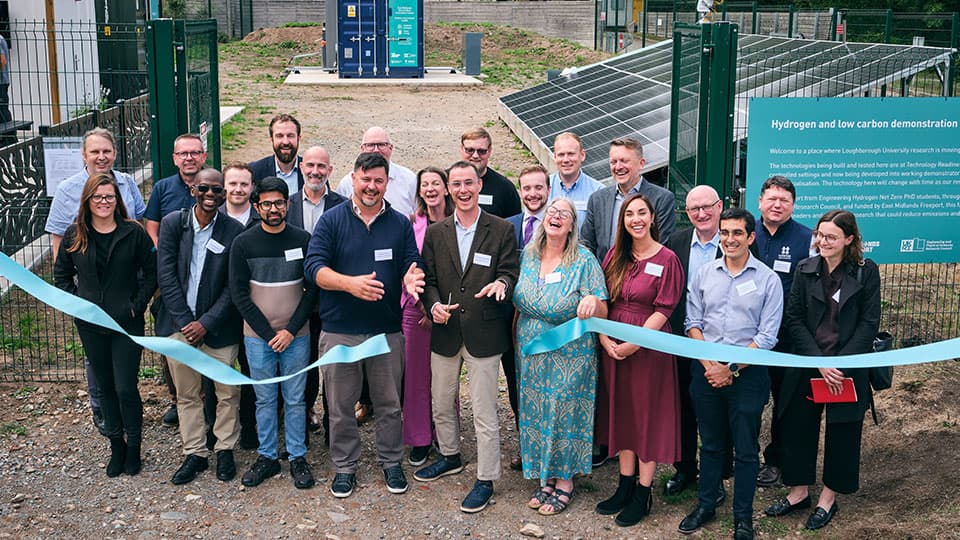
The UK’s transition to a net zero economy depends on more than policy targets. It requires physical infrastructure where new energy technologies can be tested safely, demonstrated at scale, and prepared for commercial deployment. On 10 September 2026, Loughborough University marked a significant milestone in that effort by officially opening the East Midlands Zero Carbon Innovation Centre (EMZCIC), an outdoor facility built for hydrogen research, net zero innovation, practical training, and industry collaboration.
Majority funded by the East Midlands Freeport, the centre forms part of a wider network of low-carbon and manufacturing facilities developed alongside the University of Nottingham. For students, researchers, and businesses across the UK, it represents one of the most substantial recent investments in the region’s hydrogen capability.
This article explains what the Zero Carbon Innovation Centre offers, the technology being demonstrated on site, and how students, doctoral researchers, and companies can get involved.
A New Hub for Hydrogen Research in the East Midlands
The opening event attracted around 90 guests from academia, industry, and local government, including representatives from partner organisations across the region. Tom Newman-Taylor, Chief Executive of the East Midlands Freeport, formally opened the facility, highlighting the strategic importance of universities to the area’s economic future.
The centre has been built around three core objectives:
- Scaling research safely: providing a secure platform to take hydrogen and net zero research from laboratory prototypes to larger-scale demonstrator projects, showcasing the work to investors and helping attract high-value jobs to the East Midlands.
- Delivering practical training: giving Loughborough students, along with learners from the Institute of Technology and other universities in the region, hands-on experience with operational hydrogen systems.
- Supporting doctoral research: backing the EPSRC-funded EnerHy Centre for Doctoral Training, based at Loughborough University, where students on industry and academia funded projects can take laboratory work to demonstrator scale.
These objectives reflect a deliberate regional strategy. The East Midlands Freeport has positioned itself as a driver of advanced manufacturing and clean growth, and the new centre gives that ambition a physical base. As Newman-Taylor noted at the opening, the region’s universities are among its greatest assets, and the centre showcases expertise that already exists locally while strengthening the East Midlands’ reputation as a destination for innovation.
Considering a research career in clean energy? Explore postgraduate research degrees at Loughborough University to see where hydrogen and net zero research could take you.
Inside the Zero Carbon Innovation Centre: Facilities and Capabilities
What distinguishes this facility is its outdoor configuration. Hydrogen demonstration and hardware testing carry specific safety requirements, and an open-air environment allows larger experiments than indoor laboratories can typically accommodate. The centre complements the indoor facilities at the recently opened site on the University of Nottingham’s Jubilee Campus, giving the two institutions a combined regional capability.
From Laboratory Bench to Demonstrator Scale
One of the persistent challenges in energy research is the gap between laboratory success and commercial deployment. Technologies that perform well at bench scale often encounter engineering, safety, and integration issues when tested at larger scale. The Zero Carbon Innovation Centre is designed specifically to close that gap.
The facility provides the supporting technology researchers need to run demonstrator projects, including:
- Reconfigurable solar panels that can be arranged to suit different experimental setups
- Water and hydrogen supplies to support electrolysis and fuel cell research
- A hydrogen offtake system, demonstrated through a hydrogen-powered cooker, showing how produced hydrogen can serve practical end uses
The centre’s systems are also configurable by design. Industry partners can bring their own hardware to the site, install it alongside the university’s infrastructure, and test it under realistic conditions. This flexibility makes the centre a shared platform for the wider low-carbon technology community rather than a closed academic laboratory.
Training the Workforce for a Hydrogen Economy
Research facilities alone do not build a hydrogen economy; skilled people do. The centre will provide hands-on training for Loughborough students and learners from the Institute of Technology and other East Midlands universities, giving them direct experience with hydrogen systems at a time when the UK energy sector faces a well-documented skills shortage.
Want to study at a university investing in net zero infrastructure? Browse Loughborough University’s undergraduate and postgraduate courses to find a programme that matches your career goals.
Supporting Doctoral Research Through the EnerHy CDT
The centre also plays a direct role in postgraduate research. It was purpose-designed to support the EPSRC-funded EnerHy Centre for Doctoral Training, based at Loughborough University. Students on the programme carry out research projects funded by both industry and academia, and the centre’s facilities allow them to scale laboratory work to demonstrator level.
For prospective doctoral candidates, this access matters. Outdoor demonstration infrastructure is rare in UK universities, and it enables PhD researchers to produce work with genuine commercial relevance alongside their academic publications.
The Battery-Electrolyser: Combining Energy Storage and Hydrogen Production
Among the technologies on display at the centre is Loughborough University’s battery-electrolyser, a device that combines energy storage and hydrogen production in a single unit. Its development has received £3 million as part of a wider £12 million programme of grant-funded research to scale the technology.
The engineering logic is straightforward. Electrolysers and batteries are usually separate systems, each with its own cost, footprint, and efficiency losses. By integrating both functions into one device, the battery-electrolyser could reduce the cost and complexity of renewable energy installations that need both electricity storage and hydrogen supply.
The technology has already been proven outside the laboratory. A similar unit has been commissioned in Malawi, where it provides renewable electricity and produces hydrogen for clean cooking at a hospital. That deployment demonstrates the technology’s range, from industrial applications in the UK to essential services in regions with limited grid access.
The unit’s presence at the Zero Carbon Innovation Centre is strategic. The technology is now seeking commercial support to scale further, and the centre gives potential investors and partners a place to see it operating first-hand.
Why the East Midlands Matters for Net Zero Innovation
The East Midlands has a long industrial heritage, and the region’s economic strategy now centres on advanced manufacturing and clean technology. The East Midlands Freeport’s decision to majority fund the centre reflects a calculated approach: combining university research strength with targeted investment to attract funding, support business growth, and create high-value jobs.
Professor Dan Parsons, Pro-Vice-Chancellor for Research and Innovation at Loughborough University, described the opening as being about ‘connecting complementary strengths’, adding that the centre is ‘just the first step in that progress’. The partnership with the University of Nottingham illustrates that thinking, with each institution contributing distinct facilities towards a shared regional capability.
If your organisation works in hydrogen, energy storage, or low-carbon manufacturing, learn more about collaboration opportunities with Loughborough University and discuss testing your hardware at the centre.
Loughborough University’s Broader Research Strengths
The new centre sits within a strong research environment. In the Research Excellence Framework (REF) 2021, over 90% of Loughborough’s research was rated as world-leading or internationally excellent. The university holds five stars in the independent QS Stars rating scheme and ranked eighth in the Complete University Guide 2027, a top-10 position it has maintained for more than a decade alongside institutions such as Oxford, Cambridge, and Imperial.
Loughborough is internationally recognised for sport, ranking first in the world for sports-related subjects in the QS World University Rankings for the tenth consecutive year. Its engineering and energy research, however, carry equal weight, and the Zero Carbon Innovation Centre adds a distinctive new dimension to that portfolio.
Opportunities for Students and Researchers
For anyone considering where to study hydrogen research, energy engineering, or environmental science in the UK, facilities should factor heavily into the decision. Few universities offer students the chance to work with outdoor hydrogen demonstration equipment, reconfigurable solar arrays, and integrated electrolysis systems.
The benefits vary by level of study. Undergraduates gain practical training embedded in their courses. Master’s and PhD students, particularly those connected to the EnerHy CDT, get access to demonstrator-scale testing that strengthens both their research output and their employability. Learners from across the East Midlands, including those at the Institute of Technology, can use the facility as part of regional skills development.
Not sure which route into hydrogen research suits your background? Order a prospectus or attend an open day to see the facilities for yourself.
Taking the Next Step in Hydrogen Research
The East Midlands Zero Carbon Innovation Centre is more than a new facility. It connects laboratory discovery to real-world demonstration, equips students with practical skills, and gives businesses a site to test and prove their technologies. It also signals how the UK intends to build its hydrogen economy: through regional partnerships, university-led research, and direct collaboration with industry.
For prospective students, doctoral researchers, and companies exploring hydrogen technologies, the centre offers concrete ways to engage with the net zero transition.
Have questions about studying or researching at Loughborough University? Write to us or share your thoughts in the comments below. You can also explore our related articles for further reading on hydrogen research, energy innovation, and university life in the UK.