
Advance UK Career Development Through University of Exeter Degree Apprenticeships
How Degree Apprenticeships Bridge the Gap Between Work and Postgraduate Study
Professionals in technical and engineering sectors often face a difficult choice: step away from their careers to pursue advanced education or remain in the workforce while missing out on formal qualifications. Degree apprenticeships provide a practical solution to this challenge by integrating postgraduate study directly with full-time employment. A recent cohort of employees from a leading UK helicopter firm demonstrated exactly how this model works in practice by completing a Digital and Technology Solutions Master’s Degree Apprenticeship at the University of Exeter.
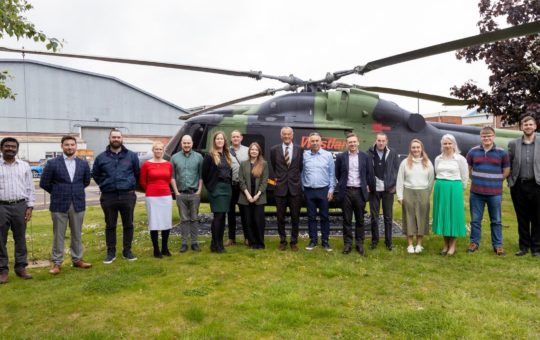
Eleven employees from Leonardo Helicopters successfully balanced their demanding day-to-day roles at the aerospace manufacturer with rigorous academic requirements over a two-year period. Rather than treating work and study as separate entities, these professionals applied classroom concepts directly to their active projects. This synergy allows organizations to retain experienced staff while simultaneously upgrading their internal capabilities. For professionals targeting long-term UK career development, this structure provides a clear pathway to senior technical and leadership roles without the financial burden of pausing employment.
Schedule a free consultation to learn more about how degree apprenticeships can fit into your professional goals.
Developing Critical Skills for Digital Transformation
Modern manufacturing and engineering firms are undergoing rapid digital transformation. Upgrading legacy systems, analyzing large volumes of operational data, and implementing machine learning algorithms are no longer optional initiatives; they are requirements for remaining competitive. The curriculum pursued by the Leonardo Helicopters cohort was specifically designed to address these industry demands.
Data Analysis and Machine Learning in Practice
Within an aerospace environment, data is generated constantly—from flight telemetry to supply chain logistics and component lifecycle tracking. The University of Exeter programme equipped the apprentices with advanced skills in data analysis, data visualization, and data engineering. Participants learned how to structure complex datasets and build models that extract actionable insights.
Furthermore, the inclusion of machine learning modules prepared these employees to move beyond basic reporting. By understanding predictive algorithms, the apprentices can now contribute to projects that anticipate maintenance needs, optimize inventory, and improve overall operational efficiency. For a helicopter firm, where safety and precision are paramount, the ability to predict component wear before it becomes a critical issue represents a substantial operational advantage.
Leadership and Change Management for Tech Professionals
Technical skills alone rarely drive successful organizational change. Implementing new digital tools requires managing human factors, overcoming resistance, and aligning new processes with broader business objectives. Recognizing this reality, the degree apprenticeship placed a strong emphasis on business and change management, as well as management and leadership in technology.
Apprentices studied how to evaluate the business value of technology investments, communicate technical concepts to non-technical stakeholders, and lead teams through periods of transition. This combination of hard data skills and soft leadership competencies prepares graduates to take on project management and strategic roles, ensuring that digital transformation initiatives actually deliver their intended return on investment.
The Business Impact of Investing in Employee Education
Employers often hesitate to invest in advanced education due to concerns about time commitment and return on investment. The experience of Leonardo Helicopters illustrates the tangible business impact that degree apprenticeships can generate. During a recent celebration event marking the completion of the programme, senior leaders noted that the projects presented by the apprentices demonstrated both academic excellence and direct applicability to the company’s bottom line.
Dario Iannucci, Head of Digital Transformation and Sustainability at Leonardo Helicopters, highlighted that the partnership with the University of Exeter enabled colleagues to develop advanced skills while simultaneously delivering meaningful improvements across the organization. When employees complete work-based projects as part of their academic assessment, the organization effectively subsidizes its own operational improvements. The apprentices identify inefficiencies, test new data models, and propose optimized workflows that can be implemented immediately.
Additionally, funding degree apprenticeships through the UK Apprenticeship Levy allows large organizations to utilize existing tax contributions to upskill their workforce, making the financial equation even more favorable. Retaining institutional knowledge while upgrading the skill set of experienced employees reduces the costs and risks associated with external hiring for senior technical roles.
Explore our related articles for further reading on how corporate education strategies improve operational efficiency.
Transferring Academic Research into Industry Practice
One of the persistent challenges in higher education is ensuring that academic research reaches the industries that can benefit from it. Traditional degree programmes often operate in isolation from the commercial sector, resulting in a gap between theoretical knowledge and practical application. Degree apprenticeships are explicitly designed to close this gap.
Dan Hallam, Head of Degree Apprenticeships at the University of Exeter, noted that the Leonardo cohort acted as a direct bridge between university research and industry practice. By engaging with leading academic thinking in data, digital transformation, and technology leadership, the apprentices were able to filter, adapt, and apply those insights within their daily roles. The result is a two-way transfer of knowledge: the university gains a deeper understanding of current industry challenges, while the employer benefits from the latest academic methodologies and fresh perspectives.
This dynamic is particularly valuable in specialized sectors like aerospace. A helicopter firm operates under strict regulatory frameworks and unique engineering constraints. When academic concepts are tested against these real-world parameters, both the university and the employer gain insights that would be impossible to achieve in a purely academic laboratory setting.
Have questions? Write to us to discuss how academic-industry partnerships work in practice.
Evaluating the Work-Study Balance in a Master’s Programme
Pursuing a master’s degree while working full-time requires a significant commitment. Professionals considering this route must evaluate their capacity for rigorous time management. The two-year Digital and Technology Solutions Master’s programme demands that participants allocate dedicated hours to reading, research, and assignment completion outside of their standard working hours.
Successful participants typically rely on strong support systems within their workplace. Employers must be willing to provide flexibility, such as adjusted schedules during exam periods or designated time for work-based learning projects. At Leonardo Helicopters, the visible support from senior leadership—including the Head of Digital Transformation—signaled to the apprentices that their academic efforts were valued and aligned with corporate strategy.
For individuals, the key to managing this balance lies in immediately applying coursework to daily tasks. Rather than treating academic assignments as separate chores, effective apprentices use their workplace as a testing ground. Analyzing a real supply chain dataset for a class project, for example, simultaneously fulfills an academic requirement and addresses a professional responsibility, effectively doubling the value of the time spent.
Submit your application today if you are ready to integrate postgraduate study with your current career.
Building a Future-Proof Workforce in the UK
The collaboration between the University of Exeter and Leonardo Helicopters serves as a compelling case study for the broader UK economy. As industries across the board face skills shortages in data science, machine learning, and digital leadership, degree apprenticeships offer a scalable mechanism for developing domestic talent. By linking higher education directly to employment outcomes, these programmes ensure that the UK workforce remains competitive on a global scale.
For organizations, establishing a pipeline of degree apprentices creates a culture of continuous improvement and learning. Employees who participate in these programmes often become internal advocates for digital transformation, mentoring junior staff and driving innovation from within. For professionals, the opportunity to earn a master’s degree without accumulating student debt, while maintaining career momentum, represents one of the most efficient models for UK career development available today.
As digital technologies continue to evolve, the demand for professionals who can bridge the gap between technical execution and strategic business leadership will only increase. Programmes like the Digital and Technology Solutions Master’s Degree Apprenticeship provide the exact framework needed to meet that demand, producing graduates who are prepared to lead complex technical initiatives from day one.
Share your experiences in the comments below regarding work-based learning and professional development.