
Water Discovery on 2D Materials Could Revolutionise Anti‑icing Coatings and Energy Materials – University of Surrey Research
Largest Breakthrough in 2D Material Science
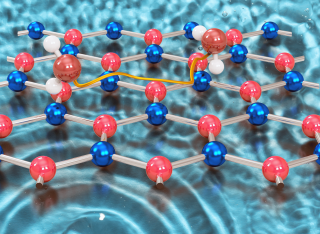
University of Surrey scientists have shown that a single layer of hexagonal boron nitride (h‑BN) behaves like a smooth walkway for water molecules, a phenomenon that has never been seen before in a two‑dimensional crystal. The discovery, published in Nature Communications, is not only a milestone for surface chemistry but also a catalyst for new technologies that rely on precise control of water at the nanoscale.
Why the “Walking” Water Matters
When a water molecule lands on graphene, it typically “jumps” from one adsorption site to another, creating a hilly trajectory that increases energy loss. On h‑BN, however, the molecule rolls across the sheet, rotating as it advances. This rolling motion means far less friction and a rapid, almost fluid, movement. The key difference lies in the electrical and structural properties of the two sheets: graphene is conductive and electrically polar, while h‑BN is an insulator with a similar honeycomb lattice but distinct charge distribution.
Impact on Anti‑icing Coatings
One of the most promising applications of this behaviour is in the design of anti‑icing surfaces. Because water spreads more smoothly on h‑BN, it can be prevented from clustering into ice nuclei. Engineers can now explore coatings that use h‑BN layers on aircraft wings or power‑line components, significantly reducing ice formation and the need for de‑icing flights.
Energy Materials and Lubrication
Low‑friction water transport also benefits next‑generation lubricants and membranes for energy storage devices. Batteries that incorporate h‑BN can offer faster ion transfer while keeping electrolytes clean and free from solid deposits. Furthermore, solar panels that self‑clean through water motion could see increased efficiency and lifespan.
The Role of the Substrate
Researchers discovered that the support material underneath the 2‑D layer changes the interaction dramatically. When h‑BN is placed on nickel, the reduced friction is most pronounced. By contrast, a copper substrate increases the binding strength, turning the smooth walk into a more hindered motion. This finding underscores that the choice of backing material is as important as the top‑layer itself.
Bridging Theory and Experiment
Experimentally, helium spin‑echo spectroscopy allowed scientists to track single‑molecule motion without disturbing the system. Computational models confirmed the observations, showing how the substrate‑induced electric fields modulate water–surface interactions. The collaboration between the University of Surrey and Graz University of Technology exemplifies how combined experimental and theoretical work can lead to groundbreaking insights.
Applications in Industry and Research
- Coatings: Develop anti‑icing paint for aerospace or civil engineering.
- MEMS: Design micro‑devices that manage fluid flow without moving parts.
- Energy Storage: Optimize battery electrolytes for higher power and durability.
- Water Treatment: Build membranes that reduce fouling through controlled water movement.
How to Dive Deeper into This Research
The full scientific article is available online and includes supplementary videos that illustrate the rolling water motion on h‑BN. Researchers and industry partners are encouraged to explore the methodology and adapt the findings to their own materials challenges.
Take the Next Step
Are you interested in collaborating on 2‑D material applications? Reach out to the research team via the University of Surrey’s contact page or schedule a consultation with the materials science department. For students, check out the available fellowships and courses that focus on nanostructured surfaces and energy technologies.