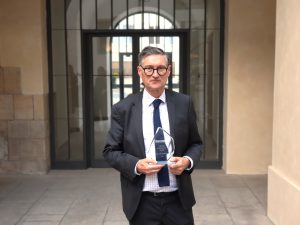
Professor Richard Whitman, a leading scholar in the School of Economics, Politics and International Relations at the University of Kent, has been honoured with a Lifetime Achievement Award by the University Association for Contemporary European Studies (UACES). Presented at the association’s annual conference in Prague, the award recognises decades of influential work in European Studies, spanning rigorous research, widely cited publications, dedicated teaching, and sustained engagement with policymakers and the media.
For prospective students, early-career researchers, and anyone with a genuine interest in UK politics and Europe’s role in the world, this recognition offers a valuable opportunity to consider what distinguishes a truly impactful academic career, and why studying alongside scholars of this calibre can shape your own path in politics and international relations.
The Story Behind the Lifetime Achievement Award
The Lifetime Achievement Award from UACES is one of the most significant honours in the field of contemporary European Studies. It is not granted solely on the basis of academic output. Instead, the award celebrates individuals who have made a lasting impact on the discipline through a combination of research excellence, publications, and teaching, alongside wider contributions such as public engagement, mentorship of the next generation of scholars, and influence on public policy.
That breadth matters. Modern academic influence is measured not only in journal articles and monographs, but in how effectively scholars explain complex political developments to the public, advise governments and think tanks, and train the students who will go on to become analysts, diplomats, journalists, and academics themselves. Professor Whitman’s recognition reflects sustained excellence across all of these dimensions, and it places the University of Kent among the institutions shaping the national and international conversation on European affairs.
Receiving the award from his peers carried particular weight for Professor Whitman. As he noted following the announcement, working to advance understanding of the politics and international relations of Europe has been an enormously stimulating experience, and to be recognised by a community of scholars from whom he has learned a great deal is an extraordinary privilege.
Richard Whitman: A Career Built on UK Politics and European Foreign Policy
Professor Whitman joined the University of Kent in 2011 and specialises in European politics and international relations. His research addresses some of the most consequential questions facing the United Kingdom and the European continent today, including UK and EU foreign, security, and defence policy, Britain’s foreign policy after Brexit, and the European Union’s evolving role on the global stage.
His career demonstrates how academic expertise can extend well beyond the seminar room. He serves as a Senior Associate Fellow at the Royal United Services Institute (RUSI), one of the world’s oldest and most respected defence and security think tanks, and as an Academic Fellow at the European Policy Centre in Brussels. Before arriving at Kent, he was Professor of Politics at the University of Bath and headed the Europe Programme at Chatham House, the leading international affairs institute.
His standing within the discipline is reflected in a series of senior roles. Professor Whitman is a Fellow of the Academy of Social Sciences and has previously served as Chair of both UACES and the British International Studies Association (BISA), the two principal scholarly bodies in his field in the UK. He is also a familiar voice in public debate, offering regular commentary on European politics and international affairs for UK and international media.
Why This Background Matters
For students evaluating where to study UK politics or European Studies, this profile is more than a list of accolades. It signals that teaching at Kent is informed by scholars who advise governments, contribute to policy debates in real time, and publish research that shapes how the discipline understands British and European foreign policy. Few learning environments offer that combination of academic depth and practical relevance.
What the Award Signals for European Studies as a Discipline
The recognition of Professor Whitman arrives at a moment when European Studies has never felt more urgent. Brexit redrew the relationship between the UK and its closest neighbours, the war in Ukraine has reshaped European security architecture, and questions about defence cooperation, trade policy, and the EU’s global influence dominate headlines on a weekly basis.
Disciplines depend on scholars who can interpret these shifts with rigour and communicate them clearly. UACES’s decision to honour a career devoted to understanding Europe’s politics underscores a simple point: sustained, careful scholarship has a lasting value that outlasts individual news cycles. For students, it also reinforces the case for studying European affairs within a department where research expertise and current affairs intersect daily.
If you are considering a degree in this field, take time to examine the research profiles of the academics who would teach you. Explore the University of Kent’s School of Economics, Politics and International Relations to see how award-winning research feeds directly into undergraduate and postgraduate teaching.
Why Learning from Award-Winning Faculty Matters for Politics Students
Choosing a university is one of the most consequential decisions any prospective student will make, and the quality of the faculty should sit near the top of the list of criteria. Here is why academics like Professor Whitman make such a difference to the student experience:
- Research-led teaching. Lecturers who are active researchers bring the latest debates, methods, and evidence into the classroom, rather than relying on dated textbooks. Students of UK politics and international relations at Kent learn from people who are writing the analysis that governments and media outlets read.
- Policy connections. Faculty affiliated with institutions such as RUSI, Chatham House, and the European Policy Centre can open doors to visiting speakers, internship pathways, and insight into how the policy world actually operates.
- Mentorship. The UACES award explicitly recognises mentorship. Supervisors with a track record of developing early-career researchers materially improve students’ chances of securing PhD places, publications, and policy careers.
- Credibility and networks. Scholars who have led major disciplinary associations carry professional networks spanning universities, think tanks, and government departments across Europe and beyond.
Seeing these qualities in a department is one of the strongest indicators that a politics degree will deliver genuine value. Book your place at an upcoming Open Day to meet academics in person and ask how their research shapes the modules you would study.
Studying Politics and International Relations at the University of Kent
The University of Kent has built a strong reputation in politics and international relations, and the presence of scholars of Professor Whitman’s standing helps explain why. Based in Canterbury, the University sits in a county whose history and geography are deeply intertwined with Europe, an hour from London and close to the continent itself.
Students in the School of Economics, Politics and International Relations can study the themes that define contemporary European affairs: British foreign policy after Brexit, security and defence cooperation, the EU’s institutions and global role, and the broader forces shaping international order. Modules are taught by specialists whose work feeds directly into the public debate, giving students an education grounded in both theory and current reality.
Beyond the classroom, Kent’s emphasis on employability, placements, and year-abroad opportunities helps students convert academic study into professional experience, whether in Westminster, Brussels, or international organisations.
If European affairs and UK politics are where your interests lie, now is the right time to act. Browse undergraduate courses or investigate postgraduate options to find a programme that matches your ambitions, and submit your application before the next intake closes.
Lessons from a Distinguished Career for Aspiring Scholars and Analysts
There is much that students and early-career professionals can learn from the shape of Professor Whitman’s career:
- Build deep expertise, then broaden it. His work moves between UK foreign policy, EU security, and international relations more broadly, showing how specialism and breadth reinforce one another.
- Engage beyond academia. Think tank fellowships and media commentary amplified the reach of his research. Analysts who can write for both specialist and general audiences are consistently in demand.
- Invest in institutions. Chairing UACES and BISA demonstrates a commitment to building the discipline itself. Serving your professional community creates relationships and opportunities that endure.
- Mentor deliberately. The most respected careers are those that lift others. Whether you become an academic, civil servant, or journalist, developing junior colleagues multiplies your impact.
For those considering doctoral study in European Studies or international relations, following the work of scholars like Professor Whitman is an excellent way to identify research questions that matter and to understand the standards the field expects. Explore postgraduate research opportunities and find a potential supervisor whose expertise aligns with your interests.
Taking the Next Step in Politics and European Studies
The Lifetime Achievement Award conferred on Professor Richard Whitman is, above all, a story about the long-term value of serious scholarship on UK politics and Europe. It affirms that careful research, generous mentorship, and active public engagement leave a mark on a discipline, on a university, and on the students fortunate enough to learn from them.
For readers inspired by this recognition, the next step is straightforward: investigate the departments where such scholars work, attend an Open Day, and speak directly with the academics whose research you admire. Arrange a campus visit to the University of Kent to see the School of Economics, Politics and International Relations first-hand.
Have questions about studying European Studies or building a career in politics and international relations? Share them in the comments below, and explore our related articles on choosing the right politics degree, funding your postgraduate study, and turning an international relations education into a policy career.