
Analyze the University of Surrey’s Sublimating Plastic in UK Plastics and Recycling News
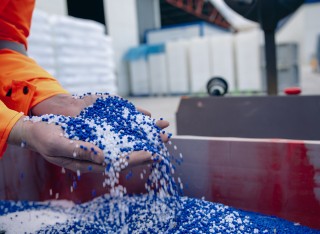
How the University of Surrey is Advancing UK Plastics Research
The persistent nature of conventional plastics has long presented a significant challenge for environmental sustainability and industrial processing. Materials like polyethylene—found in everything from carrier bags to food packaging—are highly stable, insoluble, and hydrophobic. While these properties make them incredibly useful for everyday applications, they also render conventional plastics notoriously difficult to recycle or remove once they have served their purpose. Recent plastic news from the University of Surrey introduces a fundamentally different approach to polymer design, offering a proof of concept that could eventually change how specific materials are processed, applied, and recovered.
Published in the journal Macromolecules, the study led by Dr. Peter Roth and postgraduate researcher Touseef Kazmi details a novel polymer that sublimates at relatively low temperatures. Unlike traditional materials that melt into a liquid state before degrading, this innovative polymer converts directly from a solid into a gas. As the vapor cools, it spontaneously reforms into the original solid polymer without any loss of its fundamental properties. This development represents a notable milestone in UK plastics research, providing a new framework for designing circular materials.
Schedule a free consultation to learn more about how academic research translates into industrial applications.
The Mechanics of Sublimating Polymers in Innovative Materials UK
To appreciate the significance of this Surrey news, it is necessary to understand the limitations of current chemical recycling methods and how this new material bypasses them. The chemistry behind this polymer shifts the focus from creating indestructible plastics to creating highly reversible ones.
Conventional Chemical Recycling vs. Gas-Phase Depolymerisation
Chemical recycling has emerged as a necessary alternative to mechanical recycling, which often degrades the quality of plastic over successive uses. However, current chemically recyclable polymers have substantial industrial limitations. They typically require temperatures ranging from 150 to 200 degrees Celsius to trigger depolymerisation—the process of breaking a polymer down into its individual building blocks, known as monomers.
At these elevated temperatures, the process is energy-intensive and can lead to unwanted side reactions. Furthermore, the monomers recovered from conventional chemical recycling are usually in a liquid state. Liquid monomers generally require complex and costly secondary processing, such as distillation or purification, before they can be synthesized back into usable plastic. These additional steps reduce the overall efficiency and economic viability of chemical recycling.
The University of Surrey’s material circumvents these issues through gas-phase depolymerisation. When heated to just 90 degrees Celsius, the polymer efficiently breaks down into monomers that form a vapor. Because the recovered material is a gas, it naturally separates from non-volatile contaminants. When the vapor cools, it condenses directly back into the original waterproof polymer, eliminating the need for intensive post-depolymerisation chemical processing.
The 90-Degree Celsius Breakthrough
The relatively low activation temperature of 90 degrees Celsius is a critical factor in the viability of this research. Operating at this lower thermal threshold drastically reduces the energy required to trigger the transition. It also expands the potential range of environments in which this material could be utilized or recycled, as the heat required is easily achievable through standard industrial equipment without risking thermal degradation of the surrounding components. The polymer retains the practical characteristics of conventional plastics—it is soft, insoluble, and repels water—but behaves entirely differently under specific thermal conditions.
Practical Applications Highlighted in Recent Recycling News
The theoretical benefits of a sublimating polymer are substantial, but the University of Surrey team went further by demonstrating three concrete applications. These use cases illustrate how this innovative materials UK development could be utilized in real-world manufacturing and maintenance scenarios.
Waterproof Coatings for Complex Surfaces
Applying waterproof coatings to intricate or complex geometries is a persistent challenge in manufacturing. Liquid coatings often struggle to achieve uniform coverage on surfaces with deep crevices, undercuts, or microscopic roughness. They can pool, run off, or fail to adhere evenly. By utilizing the University of Surrey’s polymer in its gaseous state, manufacturers can allow the vapor to condense evenly across a complex surface. This gas-phase deposition ensures a uniform, waterproof polymer coating even in areas that liquid coatings cannot effectively reach.
Simplified Removal and Purification Processes
Equally important to the application of a coating is its eventual removal. Traditional waterproof coatings often require harsh chemical solvents or abrasive mechanical methods to strip away, which can damage the underlying substrate. With this new polymer, removal is as simple as applying heat. Reheating the coated surface to 90 degrees Celsius causes the polymer to evaporate entirely, leaving the substrate clean and undamaged.
Furthermore, the researchers demonstrated a purification process using a contaminated polymer mixed with a model additive. By heating the mixture, the polymer sublimated into a gas, leaving the non-volatile additive behind. The pure polymer vapor was then cooled and collected as a clean solid. This ability to easily separate the polymer from additives or contaminants is a major advancement highlighted in recent recycling news, as contamination is one of the primary barriers to effective plastic recycling today.
Share your experiences in the comments below regarding the challenges of applying or removing industrial coatings.
Limitations and the Future Trajectory of Plastic News
While the properties of this new polymer are highly promising, the researchers are careful to contextualize their findings within the broader scope of the global waste crisis. As Dr. Peter Roth explicitly notes, this material is not a replacement for conventional plastics, nor is it a standalone solution to the global plastic waste problem. The volume of plastic waste generated globally requires a multi-faceted approach involving reduction, mechanical recycling, and large-scale chemical processing.
Instead, this study serves as a proof of concept for an entirely new class of circular materials. It demonstrates that it is chemically possible to engineer a substance that offers the practical benefits of a conventional plastic—such as water resistance and structural integrity—while remaining highly reversible under mild thermal conditions. The immediate value lies in specialized applications where the ability to easily apply, remove, and purify a material justifies the development of a new polymer chemistry.
The next steps for this research involve tailoring the chemistry to adjust the properties of the polymer. By modifying the molecular structure, future researchers may be able to control the exact temperature at which sublimation occurs, alter the mechanical strength of the solid polymer, or change its hydrophobic properties. This tunability is what will ultimately determine whether this proof of concept can transition from the laboratory into commercial UK plastics manufacturing.
Explore our related articles for further reading on the advancements in chemical recycling technologies.
What This Means for the Innovative Materials UK Sector
The development of this sublimating polymer aligns closely with broader sustainability goals, specifically the United Nations Sustainable Development Goal 9 (Industry, Innovation, and Infrastructure) and Goal 12 (Responsible Consumption and Production). For the innovative materials UK sector, this type of fundamental research provides the foundational knowledge required to build a truly circular economy.
Current recycling infrastructure is largely designed around mechanical sorting and melting, processes that are ill-suited for handling complex, multi-layered, or heavily contaminated plastics. Innovations like the University of Surrey’s gas-phase polymer suggest a future where specialized materials are designed from the ground up for easy recovery. If a polymer can be purified simply by turning it into a gas, the need for water-intensive washing processes or complex solvent-based separations is eliminated.
Furthermore, this research highlights the critical role of academic institutions in driving industrial innovation. By investigating the fundamental principles of polymer chemistry, universities provide the building blocks that private sector engineers and manufacturers can eventually scale into production lines. The Surrey news regarding this study demonstrates how targeted chemical research can yield highly specific, actionable solutions for niche industrial problems—such as coating complex electronic components or protecting sensitive machinery from moisture—while simultaneously contributing to the broader discourse on material circularity.
As the demand for sustainable manufacturing practices increases, the ability to efficiently recover and reuse high-performance materials will become a major competitive advantage. The concept of a polymer that can be applied as a gas, perform as a solid, and be recovered as a pure vapor challenges the traditional lifecycle of plastics. It encourages materials scientists and engineers to look beyond simply making plastics more durable, and instead focus on making them intelligently reversible.
Have questions? Write to us! We welcome inquiries about the future of polymer chemistry and sustainable material design.
Submit your application today if you are interested in pursuing advanced studies in materials science and chemical engineering.