Alistair Currie Receives Honorary Doctorate from Brunel University: Lessons from a 30-Year Banking Career
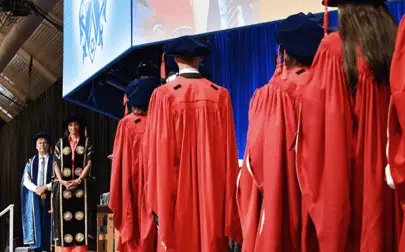
Brunel University of London recently conferred an Honorary Doctorate of Technology upon Alistair Currie, a distinguished alumnus who has spent over three decades shaping the operations and technology infrastructure of some of the world’s most prominent financial institutions. This recognition highlights not only Currie’s individual achievements but also the enduring value of applied education in preparing graduates for leadership roles across diverse industries.
The Foundation of an Applied Education at Brunel University
Currie graduated from Brunel University in 1989 with a BSc in Design and Technology, a programme that emphasized practical application over purely theoretical study. His experience reflects a core principle that has long defined Brunel’s approach to higher education: the integration of academic learning with real-world industry experience.
During his second year, Currie spent two-thirds of his time working at a marine motor manufacturing company in Hong Kong, where his family was then based. This placement was not merely an add-on to his studies but a central component of his degree. The hands-on experience allowed him to apply classroom concepts to tangible problems, developing the kind of critical thinking that would later prove invaluable in senior corporate roles.
Speaking about his educational experience, Currie noted that he would not have thrived at an institution focused solely on traditional academic instruction. Instead, he was drawn to Brunel’s reputation for combining rigorous scholarship with practical industry engagement. He described this approach as “a great combination of academia and dirty overalls,” emphasizing that true professional preparation requires both intellectual rigour and direct exposure to the messiness of real-world challenges.
Submit your application today to explore programmes that blend academic theory with practical industry experience at leading UK universities.
A Banking Career Built on Transferable Skills
What makes Currie’s career trajectory particularly noteworthy is that his degree in Design and Technology did not predict a future in banking. Yet he went on to hold senior positions at three of the world’s largest banks: HSBC, ANZ, and Barclays. Most notably, he served as Group Chief Operating Officer at Barclays Bank, where he oversaw technology, operations, and services for a global workforce of approximately 60,000 employees.
Currie now serves as an Independent Non-Executive Director of the Commonwealth Bank of Australia, continuing to influence strategic direction in the financial services sector. His career demonstrates that the skills developed through applied education—problem-solving, critical analysis, collaboration, and adaptability—translate effectively across industries and roles.
In his acceptance speech at the degree ceremony, Currie acknowledged that he never imagined his undergraduate studies would lead to a career in banking. This admission serves as a powerful reminder to current students that career paths rarely follow straight lines. The value of a university education often lies not in direct vocational training but in developing the cognitive frameworks and professional dispositions that enable success in unforeseen contexts.
Why Brunel’s Approach Remains Relevant Today
Currie’s return to the Brunel campus for the first time in 37 years provided him with an opportunity to observe how the university has evolved. He noted significant growth in infrastructure, expanded faculties, and improved facilities—evidence of sustained investment over the decades. However, he emphasized that the institution’s fundamental ethos has remained consistent.
Reviewing Brunel’s current course offerings, Currie observed that every programme maintains a clear connection to practical application, whether in science, industry, finance, law, engineering, or biosciences. This alignment with real-world needs ensures that graduates enter the workforce equipped not just with knowledge but with the ability to deploy that knowledge effectively.
The relevance of this approach has only increased in recent years. As industries undergo rapid transformation driven by technological advancement, employers increasingly seek graduates who can navigate complexity, adapt to changing circumstances, and contribute meaningfully from their first day. Programmes that integrate work placements, industry projects, and applied research provide precisely this kind of preparation.
Schedule a free consultation to learn more about how applied degree programmes can accelerate your career development.
The Role of Industry Placements in Career Development
Currie’s experience in Hong Kong exemplifies the transformative potential of industry placements. These extended periods in professional environments serve multiple functions: they allow students to test theoretical concepts against practical realities, develop professional networks, gain insight into organisational cultures, and build confidence in their ability to contribute meaningfully.
For many students, placements also clarify career aspirations—sometimes by confirming initial interests and sometimes by opening unexpected doors. Currie’s own career shift from design and technology to banking illustrates that early professional experiences need not determine one’s entire trajectory. Instead, they provide foundational skills and perspectives that prove valuable across diverse contexts.
Technology Transformation: From 1989 to the Present
Currie’s reflections on technological change offer a striking perspective on how rapidly the professional landscape has evolved. When he graduated in 1989, personal computers were not yet commonplace, the internet remained a niche curiosity, mobile phones were bulky and limited in function, and artificial intelligence existed primarily in science fiction.
Today, these technologies underpin virtually every aspect of modern life and work. For graduates entering the workforce, this transformation presents both extraordinary opportunities and significant challenges. The ability to engage with emerging technologies, assess their implications, and leverage them effectively has become a baseline expectation rather than a differentiator.
Currie’s career, which has spanned this entire period of technological revolution, demonstrates that adaptability matters more than any specific technical skill. The tools and platforms will continue to change; what endures is the capacity to learn, to question assumptions, and to approach problems with both rigour and creativity.
Have questions? Write to us! We welcome inquiries about career planning and educational pathways in the UK.
Advice for Graduates: Embracing Non-Linear Career Paths
Perhaps the most compelling aspect of Currie’s message to current graduates was his explicit encouragement to embrace uncertainty and non-linearity in their careers. He described graduation as “the end of the beginning,” a phrase that captures both the significance of completing a degree and the relatively modest position this milestone occupies within a longer professional journey.
His specific advice included several principles worth examining in detail:
Cultivate Curiosity as a Professional Practice
Curiosity drives learning, and learning drives adaptation. In a world where established practices can become obsolete within years rather than decades, maintaining genuine intellectual curiosity is not merely a personal virtue but a professional necessity. Currie’s own career shifts—from manufacturing to banking, from operational roles to strategic oversight—required continuous learning and a willingness to explore unfamiliar domains.
Embrace Change Rather Than Resisting It
Resistance to change is natural but often counterproductive. Currie’s success in senior technology and operations roles at major banks suggests an ability not merely to accept change but to actively engage with it, identifying opportunities within disruption rather than focusing solely on the accompanying challenges.
Take Calculated Risks
Career advancement often requires stepping beyond comfortable boundaries. Currie’s decision to pursue a non-traditional path from design and technology into banking represented a significant risk, particularly in an era when career trajectories were expected to be more predictable. His subsequent success validates the value of calculated risk-taking in professional development.
Release the Expectation of a Neat Career Path
The pressure to follow a predetermined path can constrain opportunities and generate anxiety when reality diverges from plans. Currie’s explicit statement that he “wouldn’t change a thing” about his non-linear career offers permission to view detours and unexpected turns as potential advantages rather than deviations from an ideal trajectory.
Share your experiences in the comments below about how your own career path has evolved beyond initial expectations.
The Significance of Honorary Doctorates in UK Higher Education
Honorary doctorates serve important functions within the UK higher education system. They allow universities to recognise individuals who have made exceptional contributions to their fields, while also creating connections between academic institutions and the broader professional world. For the recipients, these awards represent meaningful validation from their alma mater; for current students and graduates, they provide tangible examples of where a university education can lead.
Professor Stylianos Asimakopoulos, who introduced Currie’s award, described his career as exemplifying “the impact a Brunel education can have on the world stage.” This framing positions honorary doctorates not merely as celebratory events but as evidence of institutional effectiveness—demonstrations that the university’s educational approach produces graduates capable of operating at the highest levels of global industry.
For prospective students considering UK universities, news articles about honorary doctorates offer valuable insight into institutional values and the kinds of outcomes a particular educational approach can facilitate. When a university honours someone like Currie—whose success stems directly from the applied learning model that defines the institution—it signals a coherent educational philosophy rather than mere branding.
What This Means for Prospective Students Considering UK Universities
Currie’s story carries several implications for students currently evaluating their options within the UK higher education landscape:
First, it reinforces the value of programmes that integrate academic study with professional experience. The skills that enabled Currie’s transition from manufacturing to banking were not specific technical competencies but broader capacities for problem-solving, collaboration, and critical thinking—capacities developed through applied learning.
Second, it suggests that career flexibility is an asset rather than a limitation. Students who worry that their chosen degree subject will constrain their future options can take encouragement from Currie’s experience, which demonstrates that foundational skills often matter more than subject-specific knowledge.
Third, it highlights the importance of institutional culture in shaping graduate outcomes. Brunel’s long-standing commitment to practical application has produced alumni who thrive in dynamic, technology-driven environments. For students seeking similar outcomes, identifying institutions with comparable philosophies may prove more valuable than focusing solely on rankings or prestige.
Explore our related articles for further reading on UK university programmes and career development strategies.
Looking Ahead: Currie’s Continued Connection to Brunel University
Following the degree ceremony, Currie expressed his intention to renew his ties with Brunel University by engaging with current students and learning how his former degree programme has evolved. This commitment to giving back reflects a broader pattern among successful alumni who recognise the role their education played in their achievements.
For current Brunel students, the opportunity to learn directly from someone who has navigated the transition from their programme to global leadership roles represents a significant resource. Currie’s willingness to share his experiences—including the uncertainties and non-linear elements of his career—provides a model of professional development that is both aspirational and realistic.
As universities in the UK and elsewhere continue to adapt their programmes to meet evolving workforce demands, stories like Currie’s offer evidence that certain educational principles retain their value across decades of technological and economic change. The ability to think critically, apply learning to real problems, and adapt to shifting circumstances remains as relevant in 2026 as it was in 1989.