
Aftrak Secures DRIVE35 Mobilise Funding: How Loughborough University’s Agritech Spinout Is Advancing Electric Farming in the UK
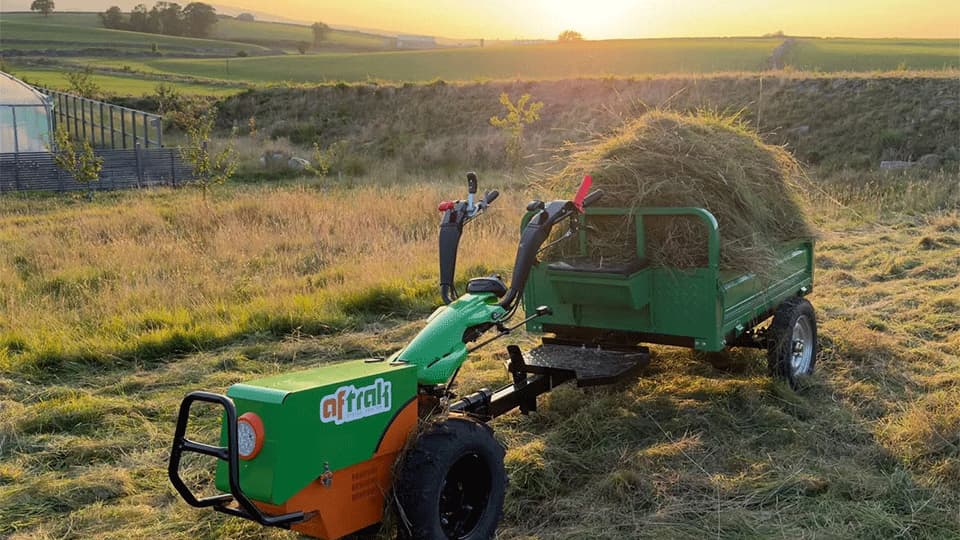
The mechanisation of small-scale farming has long involved a trade-off between cost and capability. Conventional tractors are often too expensive, too heavy and too emissions-intensive for market gardens, nurseries and urban farms. A recent announcement from Loughborough University suggests that balance is beginning to shift. Aftrak, an agritech venture co-founded by engineers at Loughborough University, has secured funding through the UK’s DRIVE35 Mobilise programme, earning a place among just 16 innovators selected by the Advanced Propulsion Centre UK (APC).
The award, worth up to £180,000 alongside structured business support, will fund further validation of Aftrak’s flagship AFT-e1 electric micro-tractor and strengthen the company’s manufacturing capability. For UK growers, the development signals that affordable, low-emission mechanisation is moving closer to commercial availability. For agritech founders and researchers, it offers a case study in how university spinouts can secure non-dilutive funding and scale internationally recognised technology.
A Competitive Funding Milestone for UK Agritech
DRIVE35 is the UK Government’s £4 billion initiative to accelerate the development and manufacture of zero-emission vehicle technologies. Within that framework, Mobilise, delivered by the Advanced Propulsion Centre UK, functions as an accelerator for early-stage companies working on electrification and propulsion innovation. Selection is competitive: Aftrak was one of only 16 companies chosen nationally, a fact that carries weight well beyond the financial award itself.
For Aftrak, the programme delivers two distinct forms of value. The first is direct funding of up to £180,000, which will support real-world validation of the AFT-e1 in British growing conditions. The second is business support: mentoring, technical guidance and access to the APC’s network of industry partners. This combination is often more valuable than the grant alone, because early-stage hardware companies frequently stumble not on engineering but on the transition from successful prototype to repeatable, scalable manufacturing.
Professor Dan Parsons, Pro Vice-Chancellor for Research and Innovation at Loughborough University and an Aftrak board member, congratulated the team on securing what he described as a highly competitive award, noting that the Mobilise programme provides valuable support at a pivotal stage of the company’s development and will help move Aftrak from successful trials and demonstration towards full commercial deployment and manufacturing at scale.
Tracking UK agritech funding opportunities? Explore our related articles on grant schemes, innovation accelerators and clean technology investment to identify the support programmes best suited to your venture.
The AFT-e1: Practical Electric Mechanisation for Small-Scale Growers
Aftrak was founded with a clear purpose: to make mechanisation accessible to small-scale growers who are underserved by conventional agricultural machinery. The company combines expertise in engineering, battery technology and international agricultural development, drawing on the combined strengths of Loughborough University, the Consortium for Battery Innovation and the international development charity Tiyeni.
The result of that collaboration is the AFT-e1, a walk-behind electric micro-tractor designed as an affordable, low-emission alternative to conventional machinery. Its design priorities reflect the realities of small-scale farming, where capital budgets are tight, land parcels are compact, and versatility often determines whether a machine earns its place in the shed.
Hot-Swappable Battery Design
At the core of the AFT-e1 is a hot-swappable battery system. Rather than waiting hours for a recharge, an operator can exchange a depleted pack for a charged one and continue working. For commercial growers, that distinction matters: downtime during planting or harvesting windows carries a real cost, and swappable batteries allow near-continuous operation with only a modest investment in spare packs.
The battery-electric architecture also reduces running costs. Electricity is cheaper and cleaner than diesel, and electric drivetrains contain fewer moving parts, which lowers maintenance requirements over the machine’s working life. Reduced noise is a further practical benefit, particularly for urban farms, nurseries and equestrian settings operating close to residential areas or animals.
Interchangeable Attachments for Year-Round Utility
A tractor only justifies its cost if it works across seasons and tasks. The AFT-e1 addresses this through a range of interchangeable attachments, allowing a single base machine to perform cultivation, grass cutting and other operations. This modularity spreads the capital cost across multiple jobs, improving the return on investment for holdings that cannot justify specialised equipment for every task.
From Loughborough University Research to International Recognition
Aftrak’s path to UK commercialisation runs through Africa. The company’s technology has been trialled extensively in Malawi, where it supports Deep Bed Farming, a cultivation method developed to raise yields on hard, compacted soils. These trials demonstrated both the impact and the commercial potential of the technology, proving that the AFT-e1 could perform reliably in demanding field conditions.
That track record has attracted significant recognition. In 2024, Aftrak won the $1 million Milken-Motsepe Prize in Green Energy, one of the most prominent awards for sustainable energy innovation in emerging markets. In 2025, the company earned a nomination for the Earthshot Prize, the global environmental award. For a young spinout, such endorsements serve an important commercial function: they signal credibility to funders, partners and future customers.
Dr Jonathan Wilson, Lecturer in Sustainable Energy Systems at Loughborough University and Co-founder of Aftrak, welcomed the selection for Mobilise support, commenting that the success of the Malawi trials had demonstrated the technology’s impact and commercial potential in Africa, and that support from the Advanced Propulsion Centre would help take an important next step towards bringing affordable electric mechanisation to more growers in the UK.
Interested in following Aftrak’s progress or in the research behind it? Explore Loughborough University’s research and innovation pages to learn how academic engineering expertise supports ventures of this kind.
What the DRIVE35 Mobilise Funding Will Deliver in the UK
The next phase of Aftrak’s development focuses on proving the AFT-e1 in British conditions. Planned trials will involve nurseries, market gardens and urban farms: settings where the machine’s compact size, low noise and zero tailpipe emissions offer clear advantages over conventional tractors.
The platform has been designed for a broad range of small-scale agricultural applications, including:
- Horticulture: bed preparation, cultivation and crop care on market gardens and nursery sites.
- Vineyards and orchards: operations in tight rows and confined spaces where full-size tractors struggle to work.
- Protected growing environments: polytunnels and glasshouses where exhaust emissions and noise create direct problems.
- Equestrian settings: paddock maintenance and ground care with minimal disturbance to animals.
- Urban farms: food production in city environments subject to strict noise and air-quality constraints.
Beyond the trials, the funding will strengthen Aftrak’s manufacturing capability, a decisive step for any hardware venture. Moving from hand-built demonstration units to repeatable production is where many promising technologies stall, and the Mobilise programme is structured specifically to close that gap.
Considering electric machinery for your holding? Have questions about agritech innovation or low-emission farm equipment? Write to us; we welcome enquiries from growers, researchers and industry professionals alike.
Lessons for Agritech Founders and University Spinouts
Aftrak’s trajectory offers practical lessons for anyone building a technology venture from a university research base.
Assemble a genuinely multidisciplinary founding team
Aftrak’s founding partnership combined academic engineering from Loughborough University, battery-sector expertise from the Consortium for Battery Innovation and field-level agricultural knowledge from the charity Tiyeni. Each partner addressed a blind spot the others could not fill: laboratory capability alone does not understand farming economics, and development practitioners alone cannot design power electronics. Founders should seek partners who challenge their assumptions early.
Validate in demanding environments first
Proving the AFT-e1 on hard, compacted Malawian soils created evidence that transfers convincingly to UK applications. A technology that survives difficult conditions earns credibility that controlled demonstrations rarely match. For hardware founders, early deployment in a genuinely challenging market can become a marketing asset in wealthier ones.
Pursue non-dilutive funding strategically
Programmes such as DRIVE35 Mobilise provide capital and support without requiring founders to surrender equity. Competition for these awards is intense, but the combination of funding, mentoring and industry access can materially change a company’s prospects. Strong applications articulate not only what the technology does, but how the funding will overcome a specific commercial bottleneck, whether that is certification, validation or manufacturing scale-up.
Design platforms, not single products
The AFT-e1’s swappable battery and interchangeable attachments make it a platform that adapts to many markets, from African smallholdings to British vineyards. Platform thinking extends the addressable market and reduces dependence on any single customer segment, which strengthens both funding applications and commercial resilience.
Building a venture from university research? Share your experiences and questions in the comments below: which funding routes and validation strategies have worked for you?
What This Means for Small-Scale Growers in the UK
For British growers, the announcement deserves attention for three reasons. First, it signals that purpose-built electric machinery for small holdings is approaching the market, addressing a segment that conventional manufacturers have long underserved. Second, the economics are shifting: electric drivetrains offer lower fuel and maintenance costs, and modular machines spread capital expenditure across multiple tasks through the year. Third, regulatory and market pressures, from noise restrictions on urban sites to emissions expectations across retail supply chains, increasingly favour zero-emission equipment.
Growers interested in the technology can follow the upcoming trials with nurseries, market gardens and urban farms, which will generate UK-specific performance data on the AFT-e1. Evidence from those trials will help individual holdings assess whether electric mechanisation suits their terrain, crops and budgets before they commit to purchase.
The Road Ahead for Aftrak and UK Agritech
Aftrak’s DRIVE35 Mobilise award marks the point at which an internationally recognised agritech story acquires a serious UK chapter. With funding of up to £180,000, APC business support and a proven platform behind it, the company now faces the challenge every successful spinout eventually meets: manufacturing at scale. The signs are encouraging. The product is validated, the technology is award-winning, and the target market spans horticulture, viticulture, orchards, protected growing and equestrian applications.
For Loughborough University, the news underlines the value of research environments that support commercialisation alongside publication. For the wider UK agritech sector, it shows that government-backed propulsion funding can reach beyond automotive applications and into the fields, quite literally, where decarbonisation meets food production.
Stay informed: subscribe to our newsletter for regular coverage of UK agritech innovation, funding programmes and sustainable farming technology, and explore our related articles to continue reading about clean technology ventures emerging from UK universities.