
Loughborough University Advances Green Hydrogen with Battery-Electrolyser Deployment in Malawi
Addressing the Clean Cooking Crisis in Sub-Saharan Africa
In many regions of Sub-Saharan Africa, the reliance on traditional biomass for cooking remains a critical public health and environmental challenge. Charcoal and firewood are the primary energy sources for millions of households, leading to severe deforestation and catastrophic levels of indoor air pollution. According to global health data, indoor smoke from solid fuels causes millions of premature deaths annually, with women and children disproportionately affected due to their proximity to cooking fires in poorly ventilated spaces.
Transitioning populations to clean cooking solutions is a complex task that requires more than just distributing new stoves. It demands the creation of entirely new, localized energy ecosystems that can reliably support alternative fuels. Liquefied Petroleum Gas (LPG) is a common substitute, but supply chain disruptions and import dependency often make it unsustainable in rural or remote areas. This is where the localized generation of green hydrogen presents a viable, long-term alternative that bypasses fuel supply chain vulnerabilities by relying on abundant local solar resources.
The recent deployment of an integrated energy system at Mwanza District Hospital in Malawi demonstrates how targeted engineering can address these specific regional challenges. By providing a sustainable fuel source directly at the point of use, this infrastructure project illustrates a practical pathway away from charcoal dependency. Share your experiences in the comments below regarding the challenges of implementing renewable energy systems in rural healthcare settings.
How the Battery-Electrolyser Technology Works
At the technical core of the Malawi deployment is a novel battery-electrolyser system developed by researchers at Loughborough University in the UK. Traditionally, renewable hydrogen production requires two distinct pieces of hardware: a battery system to store intermittent solar or wind energy, and a separate electrolyser to draw from that battery and split water into hydrogen and oxygen. Managing these two separate systems requires complex power electronics and control systems, which increases both the capital cost and the maintenance burden.
The innovation from Loughborough University lies in combining these two functions into a single, unified lead-acid unit. This world-first 20kWh-scale system functions simultaneously as an energy storage device and a hydrogen generator. When the connected solar microgrid produces excess electricity, the lead-acid cells use that energy to produce hydrogen at a purity exceeding 99%, rather than merely storing the electrons chemically in the standard lead-sulfate reaction.
The Strategic Advantages of Lead-Acid Materials
A deliberate and strategic choice in this engineering design is the use of lead-acid chemistry rather than modern lithium-ion or rare-earth-dependent alternatives. While lithium batteries offer high energy density for electric vehicles, they rely on materials with highly concentrated supply chains and complex, energy-intensive recycling processes. In contrast, lead-acid batteries utilize abundant materials and benefit from a mature, highly efficient global recycling infrastructure that claims recovery rates often exceeding 99%.
For deployments in developing nations, this material choice drastically lowers the barrier to entry. Local technicians are often already familiar with lead-acid battery maintenance, and end-of-life recycling does not require exporting hazardous materials to specialized facilities abroad. By avoiding scarce, supply-constrained metals, the battery-electrolyser technology ensures that the system remains repairable, maintainable, and economically viable over a multi-decade lifecycle. A patent application has been filed for this specific integration method, protecting the intellectual property developed through this rigorous research.
The Mwanza District Hospital Implementation
Practical application of laboratory technology is where real-world value is proven. The Mwanza District Hospital in Malawi serves as an ideal testing and deployment ground because it highlights the dual energy needs of rural African healthcare facilities: reliable electrification for medical care and high-temperature energy for preparing patient meals.
The integrated system combines a solar microgrid, the proprietary battery-electrolyser, and MONBAT battery energy storage into a single cohesive platform. This setup achieves two distinct goals simultaneously. First, it electrifies critical areas of the hospital, specifically the kitchen and the wards dedicated to maternity and under-5 pediatric care. Second, it routes the generated green hydrogen directly to a Falcon cooker located in the hospital kitchen.
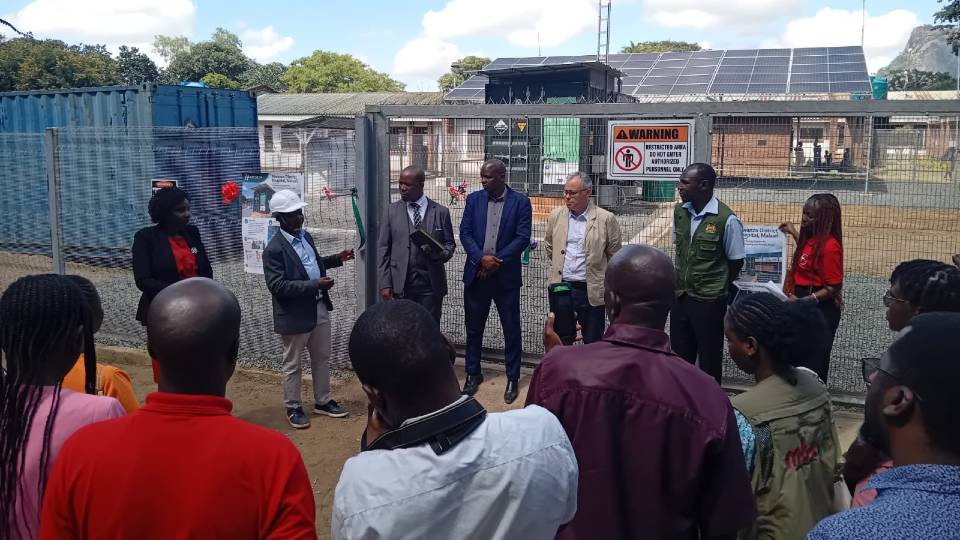
This kitchen is utilized primarily by patient guardians—family members who stay at the hospital to cook and care for their relatives. By providing these guardians with a reliable, smoke-free cooking method, the hospital significantly reduces indoor air pollution on its campus while simultaneously removing the demand for locally sourced charcoal. The formal handover ceremony, attended by the Mwanza District Council Chairperson, the District Commissioner, and a representative from the Ministry of Energy, marks the transition from a commissioned testing phase into standard live operation. Have questions? Write to us! to learn more about the technical specifications of this system.
Economic and Environmental Advantages of the MESCH Project
This deployment is not an isolated experiment but the flagship installation of the £1.5M Innovate UK Modular Energy Storage with Clean Hydrogen (MESCH) project. The economic rationale behind the MESCH project is rooted in system simplification. By combining storage and hydrogen production into one unit, the technology reduces the total number of required components, power conversion steps, and control subsystems.
This consolidation directly translates to reduced capital expenditures. Lower system costs are essential for scaling renewable energy solutions in Sub-Saharan Africa, where access to international climate finance is often bottlenecked by the high upfront costs of imported hardware. Furthermore, the modular nature of the system means it can be scaled incrementally. A small clinic could install a baseline system and add capacity as funding becomes available or energy demands increase.
The environmental advantages are equally substantial. By shifting cooking fuel from charcoal to green hydrogen, the project directly mitigates local deforestation pressures and reduces black carbon emissions. When paired with the electrification of medical wards via solar power, the hospital reduces its reliance on diesel backup generators, further cutting greenhouse gas emissions and localized air pollution. Schedule a free consultation to learn more about how modular energy systems can be integrated into existing infrastructure.
Scaling UK Innovation Globally
Moving a technology from a single successful pilot to widespread commercial adoption requires a robust strategy for replication. Professor Dani Strickland, Director of the Engineering Hydrogen Net Zero EPSRC Centre for Doctoral Training and the project lead at Loughborough University, emphasized that the Malawi handover provides the essential safety and reliability evidence required to justify replicating these systems elsewhere.
The focus is now squarely on proving repeatable performance across multiple diverse sites. The research team is already advancing deployments in Côte d’Ivoire, Zambia, and back in the UK. Testing the battery-electrolyser across different climatic conditions, solar irradiance levels, and load profiles will generate the operational data necessary to refine the control algorithms and optimize the system for mass manufacturing.
Professor Dan Parsons, Loughborough University Pro Vice-Chancellor for Research and Innovation, outlined the commercial exit strategy for this academic research. With the technology validated in the field, the immediate objective is spinning out a start-up company. This commercial entity will be tasked with scaling manufacturing, establishing supply chains, and delivering the technology to market, thereby realizing its wider impact on global clean cooking and off-grid energy access.
The Future of Green Hydrogen for Clean Cooking
The development of the combined battery-electrolyser system represents a pragmatic shift in how the development sector approaches the clean cooking crisis. Rather than waiting for hydrogen fuel cell vehicles to drive down the cost of electrolysers, or relying on the development of complex green ammonia supply chains, this solution utilizes existing, easily manufacturable chemical processes in a novel configuration.
For rural healthcare facilities in developing nations, the implications are profound. Hospitals require high reliability, and energy poverty is a direct threat to patient outcomes. A system that can guarantee electrified medical equipment while simultaneously solving the logistical nightmare of fueling patient kitchens addresses multiple institutional vulnerabilities at once.
The collaboration between UK academia, international innovation agencies like Innovate UK, and local implementation partners such as Renew’N’able Malawi (RENAMA) and INFLO provides a strong blueprint for future technology transfers. As the spin-out process moves forward, the global energy sector will be watching closely to see if this localized approach to green hydrogen can achieve the commercial scalability required to make a measurable dent in the clean cooking deficit. Explore our related articles for further reading on renewable energy innovations in healthcare infrastructure. If you are a researcher or student interested in contributing to these vital engineering challenges, submit your application today to join the next generation of sustainable technology leaders.