
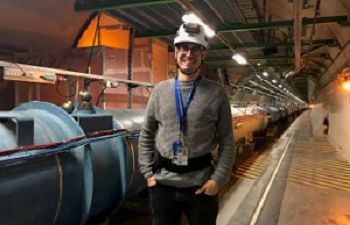
The University of Sussex has received a substantial research grant of over £800,000 from the Royal Society, earmarked for deepening our understanding of the quantum universe. This funding will support the work of experimental particle physicist Dr Josh McFayden, who will use data from CERN’s Large Hadron Collider (LHC) to investigate some of the most pressing questions in physics, including the nature of dark matter, the stability of the vacuum, and the matter–antimatter asymmetry that shaped our cosmos.
Grant Scope and Key Objectives
Dr McFayden will lead investigations on two flagship LHC experiments: ATLAS—the world’s largest and most intricate particle‑detector—and FASER, a cutting‑edge project designed to search for long‑lived particles such as neutrinos and potential dark matter candidates. The primary aims of the funded research are:
- Perform high‑precision studies of the Higgs boson and top quark to test the completeness of the Standard Model.
- Combine results from multiple LHC detectors to increase sensitivity to physics beyond the current framework.
- Explore theoretical scenarios that could explain why more matter than antimatter exists and whether unseen particles influence the cosmic vacuum.
Explore Sussex’s broader research initiatives for more on how this grant supports the university’s global scientific agenda.
Innovative Global Analyses
The project places a strong emphasis on developing state‑of‑the‑art global analyses. By synthesising data from ATLAS, FASER, and other experiments, the team will push the precision frontier, making it possible to detect subtle deviations that could hint at new forces or particles. These methods are now a benchmark for LHC physics and have the potential to guide future collider designs.
Impact on UK Research and Education
Receiving an £800k grant from the Royal Society affirms the UK’s investment in fundamental science. It also provides valuable training opportunities for graduate students, post‑docs, and research associates who will gain hands‑on experience with large‑scale data analysis, detector operation, and theoretical modelling—all skills highly prized in academia and industry alike.
Interested students and scholars can apply for a PhD at Sussex and contribute to cutting‑edge particle physics research.
Connecting Theory and Experiment
One of the most exciting aspects of this endeavour is the direct link between mathematical theory and observable phenomena. Findings from ATLAS and FASER will either confirm the Standard Model’s predictions or reveal new patterns that could reshape our understanding of the universe’s fundamental laws.
Future Directions
Should the analyses uncover unexpected signals, the research group plans to collaborate with theoretical physicists worldwide to explore viable models that explain the data. This iterative process fuels scientific progress and positions Sussex at the forefront of particle physics research globally.
Keep up with the latest developments by following Sussex’s research news pages here.
Take the Next Step in Quantum Research
Whether you’re a prospective student, a current researcher, or an enthusiast of particle physics, there are many ways to engage:
- Submit your application today to pursue a PhD in particle physics at the University of Sussex.
- Contact the research office for details on collaborative opportunities and open positions.
- Share your thoughts in the comments below or participate in the community forums dedicated to quantum science.
For more information on how Sussex is shaping the future of quantum research, visit our research website or consult the university’s strategic research roadmap.