
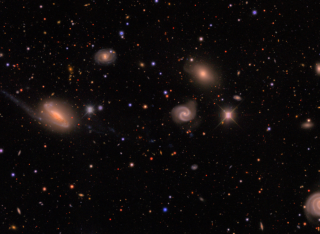
The universe is expanding, and it’s doing so at an accelerating rate. This fundamental observation, which contradicts the predictions of Einstein’s theory of General Relativity, has been one of the most profound mysteries in modern cosmology. To investigate this phenomenon, an international collaboration of over 400 scientists, including researchers from the University of Surrey, has completed the Dark Energy Survey (DES). This monumental effort has catalogued an unprecedented 669 million galaxies, providing a vast dataset to probe the nature of dark energy and the fundamental laws governing our cosmos.
For over two decades, the DES collaboration has utilized the 570-megapixel Dark Energy Camera mounted on the Víctor M. Blanco 4-meter Telescope in the Chilean Andes. Between 2013 and 2019, the team observed the southern sky for 758 nights, capturing detailed information about galaxies billions of light-years away. The latest findings, which combine measurements of galaxy clustering, gravitational lensing, and other cosmological probes, offer constraints on dark energy models that are more than twice as strong as previous analyses.
Understanding the Cosmic Acceleration Puzzle
In 1998, astronomers made a startling discovery: the expansion of the universe is not slowing down due to gravity, as previously thought, but is instead speeding up. This acceleration implies that a mysterious, repulsive force—dubbed “dark energy”—makes up approximately 70% of the universe’s total energy density. Alternatively, it could mean that Einstein’s theory of General Relativity requires modification on cosmic scales. The DES aims to distinguish between these possibilities by measuring the history of the universe’s expansion with extreme precision.
The survey’s methodology is multifaceted. By mapping the distribution of 669 million galaxies, scientists can observe how large-scale structures have evolved over time. This “galaxy clustering” data reveals how gravity has shaped the cosmic web. Additionally, the DES measures weak gravitational lensing, where the gravity of massive objects subtly distorts the light from background galaxies. This distortion provides a direct probe of the total mass in the universe, including dark matter, and how it interacts with dark energy.
The University of Surrey’s Pivotal Role
Professor Bob Nichol, Pro-Vice-Chancellor and Executive Dean of the Faculty of Engineering and Physical Sciences at the University of Surrey, has been a central figure in the DES since its inception. His leadership was instrumental in securing UK government funding for British scientists and holding several key positions within the collaboration. The University of Surrey’s involvement underscores the importance of sustained, long-term international research programs.
“The Dark Energy Survey shows the value of sustained international research programmes. Twenty-five years ago, we had questions about cosmic acceleration. Today, we’re narrowing down the answers because institutions across the world are committed to working together for the long term.”
— Professor Bob Nichol, University of Surrey
This collaborative effort highlights how academic institutions contribute to global scientific endeavors. The expertise developed in data analysis, instrumentation, and theoretical cosmology at universities like Surrey is critical for interpreting the complex data generated by projects like the DES. The findings not only advance our understanding of the universe but also drive technological innovation in imaging and data processing.
Implications for Future Cosmological Research
The results from the Dark Energy Survey set a new benchmark for cosmological measurements. The combined analysis of galaxy clustering and weak lensing provides a powerful cross-check, reducing systematic uncertainties and increasing confidence in the conclusions. These findings will inform the design and science goals of next-generation surveys, such as the Vera C. Rubin Observatory’s Legacy Survey of Space and Time (LSST) and the Euclid mission, which will continue the quest to unravel the dark energy mystery.
For students and researchers interested in cosmology, astrophysics, and data science, the DES represents a prime example of how large-scale scientific projects operate. The collaboration involves experts in observation, simulation, statistics, and theory, offering diverse career pathways. The skills developed in handling petabytes of astronomical data are highly transferable to fields like machine learning, big data analytics, and remote sensing.
How to Engage with Cutting-Edge Cosmic Research
If you are inspired by the discoveries of the Dark Energy Survey and wish to contribute to the next generation of cosmic exploration, consider pursuing advanced studies in physics, astronomy, or related disciplines. Universities with strong research groups in cosmology provide the training and resources needed to participate in international collaborations.
Many institutions offer specialized programs that cover topics from general relativity to observational techniques. Engaging with these programs allows you to work with real data from surveys like DES and develop the analytical skills necessary for a career in research or industry. Explore postgraduate programs that focus on astrophysics and cosmology to deepen your understanding of these fundamental questions.
Developing Skills in Astronomical Data Analysis
The DES dataset is a treasure trove for training in data analysis. Aspiring scientists can learn to process images, measure galaxy properties, and apply statistical methods to extract cosmological parameters. Many universities provide access to public data archives and computational resources, enabling hands-on experience. Discover research opportunities that allow you to work alongside experts on projects similar to the DES.
Contributing to International Scientific Collaborations
Participation in large-scale surveys often begins with academic training and progresses to involvement in working groups. By joining a research team, you can contribute to data collection, analysis, or theoretical modeling. The collaborative nature of these projects fosters a global network of scientists, providing invaluable professional connections. Learn about doctoral research pathways that can lead to roles in international consortia.
The Path Forward in Cosmology
The Dark Energy Survey’s catalog of 669 million galaxies is more than a numerical achievement; it is a foundational resource for testing the laws of physics on the largest scales. As the scientific community analyzes this data, new insights into dark energy and gravity will emerge, potentially reshaping our understanding of the universe’s fate.
For those passionate about unraveling cosmic mysteries, the field of cosmology offers a dynamic and impactful career. Whether through academic research, instrumentation development, or data science, there are numerous ways to contribute. The University of Surrey’s role in the DES exemplifies how dedicated research institutions drive progress in fundamental science. Contact the University of Surrey to learn more about their research programs and how you can become part of this exciting journey.
As we look to the future, the collaboration between international teams and academic institutions will continue to be essential. The questions raised by the accelerating universe challenge our current theories and inspire new generations of scientists. By engaging with these problems, you can help shape the next chapter in our understanding of the cosmos.