Background: The Sahul Landmass and Early Human Migration
For more than a century, scholars have wondered how and when modern humans crossed vast oceanic distances to settle the combined landmass of Australia and New Guinea, known as Sahul. During the last Ice Age, lowered sea levels connected these islands into a single continent, creating a terrestrial corridor that early hominins might have used to reach the region. Recent evidence, however, has suggested that the first arrival occurred not merely by chance but through deliberate maritime strategies, raising questions about the timing and routes of these voyages.
The University of Huddersfield’s Archaeogenetics Research Group, in partnership with the University of Southampton’s Centre for Maritime Archaeology, has pioneered a new genetic study that settles the long‑standing debate between a “long chronology” and a “short chronology” of Sahul settlement. This collaborative work offers fresh insights into human dispersal patterns, genetic inheritance, and the interplay between environment and migration.
Explore the university’s study programmes to learn how our research equips the next generation of scholars.
Long vs. Short Chronology: Defining the Debate
Two competing narratives dominate the field: the long chronology suggests a first settlement around 60,000 years ago, while the short chronology places it between 45,000 and 50,000 years. Both hypotheses account for archaeological artefacts, lithic technology, and palaeoenvironmental data, yet genetic evidence has remained inconclusive—until now.
By interrogating the mtDNA inherited from mothers, the cross‑disciplinary team was able to trace maternal lineages across populations that once lived in Sahul. Mitochondrial DNA provides a high-resolution timeline because mutations accumulate at a relatively stable rate, allowing researchers to estimate divergence times with reasonable confidence.
Methodological Approach: Mitochondrial DNA and the Molecular Clock
The research team screened nearly 2,500 complete mtDNA genomes from a mix of Aboriginal Australians, New Guineans, and neighbouring Pacific communities. These genomes were aligned to construct a comprehensive genealogical tree, mapping how lineages diverged. The team then applied the molecular clock—a technique that uses the accumulation of mutations to count the passage of time—to date the most basal lineages found in Sahul.
While other studies have used whole nuclear genomes, this project focused on mtDNA because of its prevalence in archaeological samples and its direct matrilineal inheritance.
Key Findings: 60,000 Years Ago and Two Migration Routes
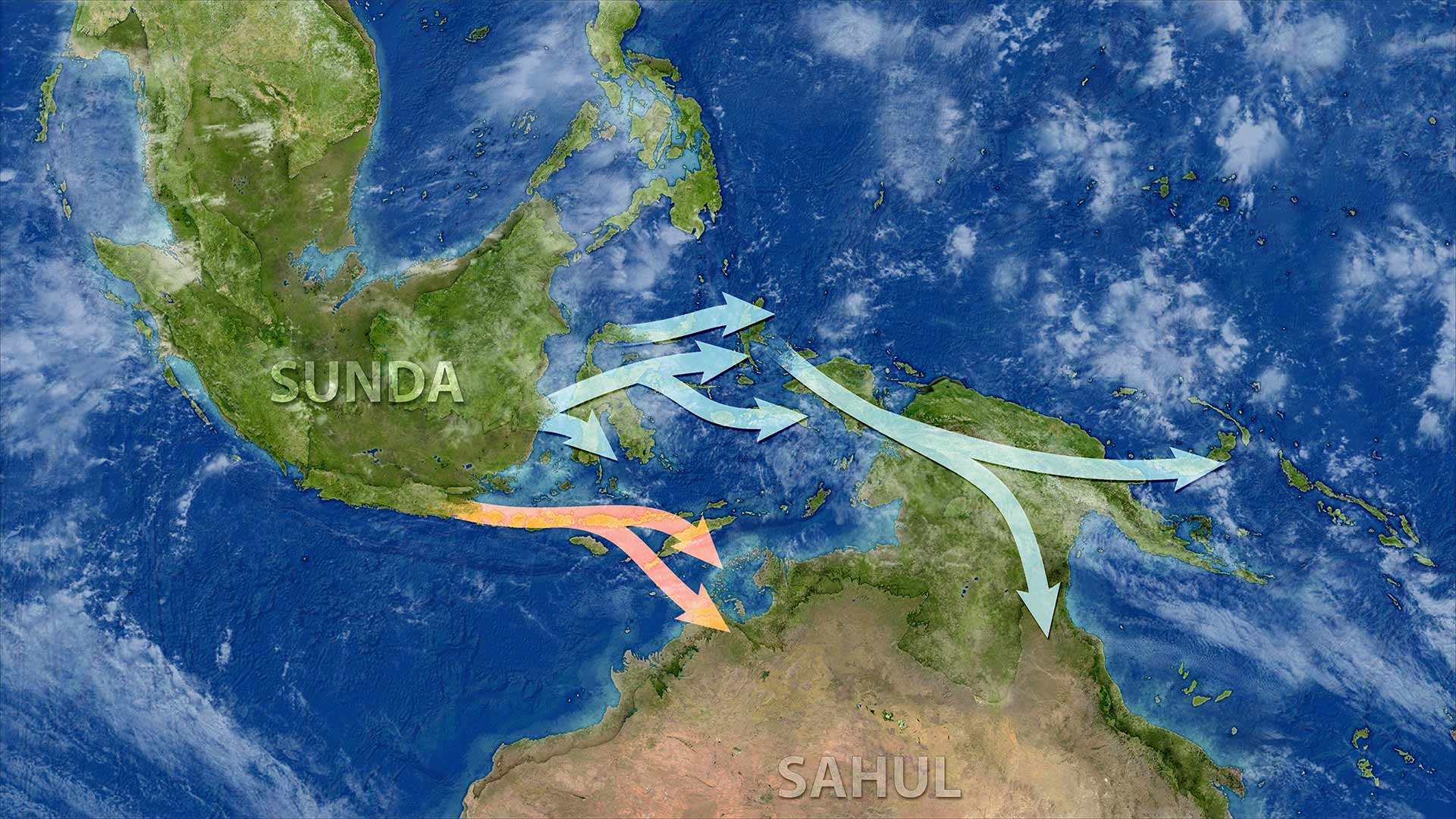
The analysis revealed that the oldest lineages present in both Aboriginal Australians and New Guineans diverged roughly 60,000 years ago, supporting the long‑chronology view. Intriguingly, these lineages traced back to two distinct regions of Southeast Asia: one group from northern areas such as Java and the Philippines, and another from southern zones including Malaysia and Indochina.
These results not only anchor the earliest Sahul settlement to a 60,000‑year mark but also imply that early seafarers employed multiple maritime routes. Modern scholarship now recognizes that rather than a single, linear migration, early human groups might have taken diverse paths across the Austronesian sea lanes, adapting to prevailing winds, currents, and resource availability.
For more detailed data, download the research paper from Science Advances.
Implications for Maritime Archaeology and Indigenous History
These genetic findings dovetail with archaeological records that indicate the presence of seafaring technologies in the region at or before 60,000 years. The conjunction of DNA evidence, paleoclimatic modelling, and artefacts reinforces the notion that early humans possessed sophisticated maritime skill sets. This, in turn, resonates with Indigenous oral histories that emphasize ancestral voyaging and deep familiarity with the sea.
Studying the routes and timelines of early maritime migration offers invaluable context for contemporary discussions about cultural heritage, renewal of traditional ecological knowledge, and the resilience strategies of early Australian societies.
Future Directions: Whole-Genome Sequencing and Ancient DNA
Professor Richards noted that mtDNA provides only one lineage trajectory. The team is currently analysing hundreds of whole human genome sequences—each comprising about 3 billion bases—to obtain a more nuanced picture that includes paternal lines and autosomal inheritance. These analyses will allow researchers to cross‑validate the molecular clock estimates against other genomic markers.
In parallel, field efforts aim to recover ancient DNA from archaeological remains in southwestern Australia and Papua New Guinea. Success in retrieving such samples would provide the most direct evidence, allowing scientists to reconstruct genetic signatures from the very earliest inhabitants.
Enhancing the University of Huddersfield’s Profile in Global Research
By spearheading this high‑impact study, the University of Huddersfield demonstrates its capacity for interdisciplinary collaboration, state‑of‑the‑art laboratory work, and contributions that resonate across the humanities and STEM fields. The project exemplifies the UK genetic research leadership that the university proudly promotes, positioning itself as a hub for researchers interested in archaeology, genetics, and oceanography.
You can learn more about the research group’s other international collaborations and how they shape contemporary scholarship.
How to Engage: Opportunities for Students and Researchers
Students wishing to specialize in archaeological genetics or maritime archaeology may benefit from enrolling in the University’s relevant modules or short courses. Explore undergraduate courses and enquire about research placements that let you work directly with the labs handling mtDNA sequencing.
Experienced researchers are invited to contact the department for potential joint grant applications, data sharing agreements, or collaborative field expeditions.
Take the Next Step: Join the Conversation
We invite scholars and enthusiasts alike to register for our upcoming webinar on the implications of the long chronology for contemporary maritime archaeology. This session will feature the study’s principal investigators and provide a platform for interactive Q&A.
To stay updated on the latest research and related projects, sign up for our newsletter and follow us on social media. For more specialized resources, visit our research portal to access datasets, publications, and ongoing calls for contributors.
Interested in pursuing a career in genetic archaeology? Submit your application today and join students who are shaping the future of interdisciplinary research.