
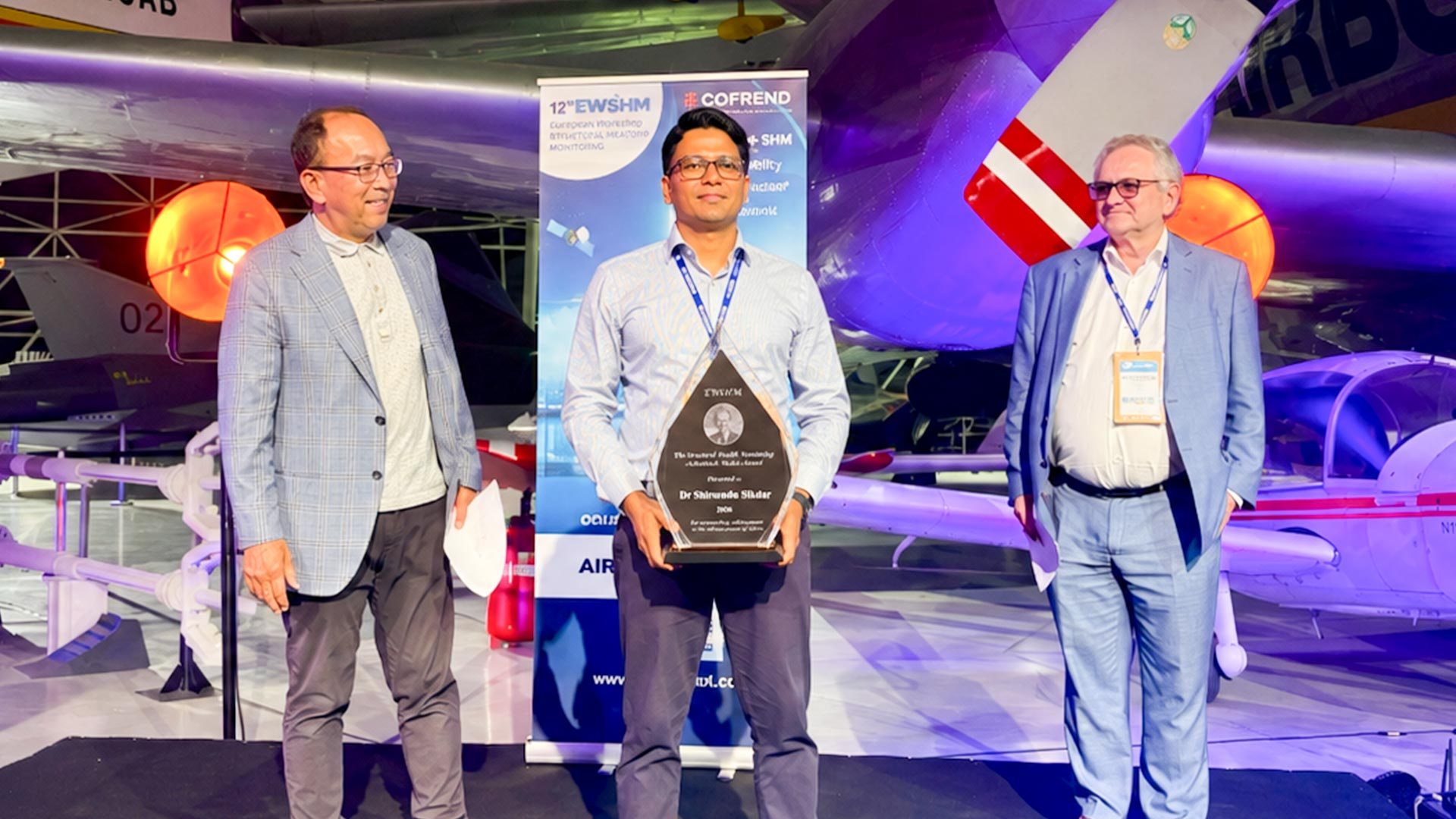
University of Huddersfield Mechanical Engineering Expert Wins Achenbach Medal for Structural Health Monitoring
Defining Structural Health Monitoring in Modern Engineering
Evaluate the safety of the bridges you cross, the aircraft you fly in, and the wind turbines that generate your power. Ensuring the integrity of these structures requires continuous, precise assessment. Structural Health Monitoring (SHM) represents the shift from periodic, manual inspections to continuous, automated surveillance of engineering assets. By integrating advanced sensors directly into materials, engineers can detect anomalies, quantify damage, and predict failure before it occurs.
Within the realm of UK Engineering, SHM has become a critical discipline. As infrastructure ages and new materials like advanced composites become standard, traditional visual inspections are no longer sufficient. SHM provides real-time data on structural performance, reducing maintenance costs and preventing catastrophic failures. The recent recognition of a University of Huddersfield academic highlights the rapid advancements occurring in this specialized field.
Schedule a free consultation to learn more about our engineering programs.
The Significance of the Achenbach Medal for Early-Career Researchers
Recognize the Achenbach Medal as the highest international distinction for early-career researchers in the SHM community. Named after J. D. Achenbach, a pioneer whose scientific work laid the foundational theories for modern wave propagation and structural health monitoring, this award sets a rigorous standard for academic excellence. The medal is exclusively awarded to researchers within ten years of completing their PhD who have demonstrated exceptional contributions to the science and technology of structural monitoring.
Dr. Shirsendu Sikdar, a Senior Lecturer in Mechanical Engineering at the University of Huddersfield, received this prestigious award at the 12th European Workshop on Structural Health Monitoring in Toulouse, France. Earning the Achenbach Medal places Dr. Sikdar among an elite group of global researchers who are actively defining the future of non-destructive evaluation (NDE). For the University of Huddersfield, this accolade reinforces its position as a central hub for high-impact engineering research and innovation.
Integrating Intelligent Monitoring Technologies for Critical Infrastructure
Understand how Intelligent Monitoring Technologies are changing safety protocols across multiple industries. Dr. Sikdar’s award-winning research focuses on the convergence of several complex disciplines: ultrasonic guided waves, acoustic emission, smart-sensing, machine learning, and cyber-physical systems. Combining these technologies allows for the creation of autonomous damage detection systems that operate without constant human intervention.
Consider the application of ultrasonic guided waves in aerospace engineering. Unlike bulk waves, guided waves can travel long distances through thin structures like aircraft fuselages, interacting with microscopic cracks or delaminations along the way. This active testing method involves sending a signal and analyzing the returning echoes. In contrast, acoustic emission serves as a passive monitoring technique, listening continuously for the high-frequency stress waves generated organically by growing cracks as the aircraft experiences flight loads. Pairing these active and passive methodologies provides engineers with a highly redundant and comprehensive view of structural health.
Apply machine learning algorithms to the massive datasets generated by these sensors, and the system moves from simple data logging to predictive maintenance. The algorithms learn the baseline acoustic and ultrasonic signatures of a healthy structure, flagging deviations that indicate damage. This integration is particularly vital for monitoring hydrogen energy technologies, where hydrogen embrittlement can cause sudden material failure, and for wind turbine blades, which endure extreme, variable loads.
Explore our related articles for further reading on non-destructive evaluation.
The Smart-SHM & NDE Research Team at the University of Huddersfield
Examine the collaborative environment that fosters such high-level innovation. Since joining the University of Huddersfield in 2023, Dr. Sikdar established and now leads the Smart-SHM & NDE Research Team. This interdisciplinary group brings together experts in mechanical engineering, data science, and materials science to develop next-generation intelligent monitoring technologies for sustainable engineering systems.
Secure funding remains a significant challenge in academic research, yet the Smart-SHM team has successfully acquired approximately £1 million through competitive research grants. This funding supports active projects dedicated to intelligent monitoring systems for hydrogen energy technologies and advanced composite structures. By fostering international collaborations, the team ensures their research addresses global engineering challenges rather than isolated, localized issues.
Professor Paul Allen, Associate Dean of Research and Innovation at the School of Computing and Engineering, notes that this success reflects the ambitious and collaborative spirit inherent to the university’s research culture. The environment at Huddersfield specifically encourages researchers to push the boundaries of current Intelligent Monitoring Technologies, providing the infrastructure necessary to test and validate complex cyber-physical systems.
Have questions? Write to us in the comments below about intelligent monitoring technologies.
Advancing Cyber-Physical Systems and Digital Twins
Analyze the role of digital twins in modern Structural Health Monitoring. A digital twin is a virtual replica of a physical structure, updated in real-time by data streaming from physical sensors. Dr. Sikdar’s research utilizes cyber-physical systems to bridge the gap between physical assets and their digital counterparts.
Implement a digital twin on a wind turbine, for example. As the physical blades rotate and experience stress, ultrasonic sensors detect minor fiber breakages. This data is instantly transmitted to the digital twin, which runs simulations to predict how that damage will propagate under future wind conditions. Maintenance crews can then intervene precisely when and where necessary, minimizing downtime and extending the lifespan of the turbine. This approach represents a fundamental shift from reactive repairs to proactive asset management, saving significant capital over the lifecycle of the structure.
Real-World Applications in Aerospace and Renewable Energy
Review the specific industries benefiting from these advancements. In aerospace, advanced composite materials offer high strength-to-weight ratios but present unique inspection challenges. Internal delaminations can remain hidden from visual inspection. Intelligent monitoring systems embed sensors within the composite layers during manufacturing, providing a lifelong health record of the component from the factory floor to the end of its service life.
Look at the renewable energy sector, particularly offshore wind farms. Inspecting these structures manually requires expensive and dangerous offshore missions. By deploying smart-sensing networks utilizing acoustic emission and guided waves, engineers can monitor the structural integrity of turbine towers and blades remotely from onshore control centers, drastically improving safety and reducing operational expenditures.
Assess the emerging field of hydrogen technologies. Storing and transporting hydrogen requires specialized materials capable of withstanding high pressures and preventing gas leaks. Hydrogen atoms are exceptionally small and can infiltrate the metallic lattice of steel or other alloys, a process that leads to hydrogen embrittlement. This phenomenon severely weakens the material, making it prone to sudden, brittle fracture. Structural Health Monitoring systems provide continuous surveillance of these tanks and pipelines, utilizing acoustic emission to detect the microscopic cracking associated with embrittlement long before a leak or catastrophic failure can occur, thereby ensuring public safety and the commercial viability of green hydrogen initiatives.
Building a Career in Structural Engineering and NDE
Identify the skills required to enter this rapidly evolving field. Aspiring engineers and researchers must build a strong foundation in mechanical or civil engineering, supplemented by expertise in data analytics and programming. The integration of machine learning into SHM means that modern engineers must be as comfortable writing code to analyze acoustic data as they are calculating stress loads.
Seek out institutions that prioritize interdisciplinary research and provide access to advanced testing facilities. The University of Huddersfield’s investment in the Smart-SHM & NDE Research Team demonstrates the type of environment where early-career researchers can thrive. Working alongside experienced mentors, securing competitive grants, and participating in international workshops—like the European Workshop on Structural Health Monitoring where the Achenbach Medal is awarded—are critical steps for professional development in UK Engineering.
Submit your application today to join the next generation of engineering researchers.
The Future of Infrastructure Safety
Anticipate the next decade of developments in Structural Health Monitoring. The integration of artificial intelligence will further automate the diagnostic process, reducing the need for human interpretation of sensor data. Networks of wireless, energy-harvesting sensors will eliminate the need for batteries, allowing for permanent installations in previously inaccessible locations.
Recognize that the work of researchers like Dr. Sikdar and his team at the University of Huddersfield is setting the standards for these future systems. The Achenbach Medal not only honors past achievements but also signals the trajectory of an entire discipline. As infrastructure demands grow more complex, the reliance on intelligent, autonomous monitoring systems will become the standard, ensuring that critical structures remain safe, sustainable, and operational for decades to come.
Share your experiences in the comments below regarding structural safety.