
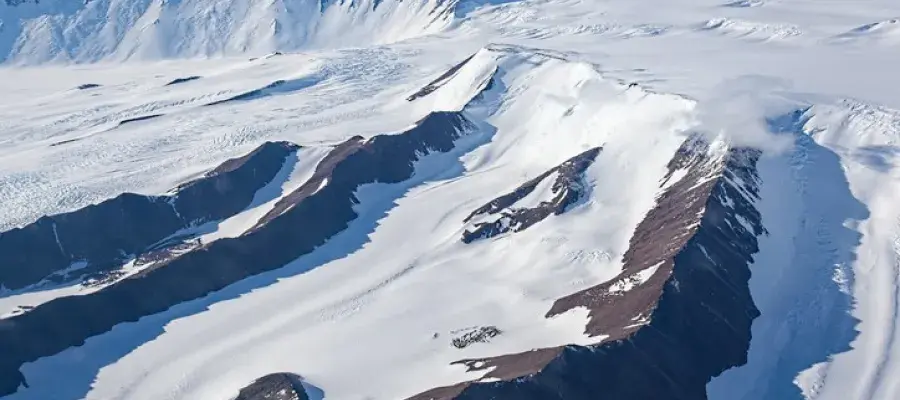
Understanding the future of global sea levels requires a detailed knowledge of Antarctica’s ice sheet. A groundbreaking study led by the University of Edinburgh has now provided the most comprehensive map to date of the hidden landscapes beneath the ice, revealing thousands of previously unknown features that are critical for accurate climate modeling.
The research team combined a novel mapping technique with satellite data to visualize the terrain across the entire continent. This achievement is not merely a cartographic milestone; it is a vital tool for predicting how the Antarctic ice sheet will respond to a warming climate. The findings, published in the journal Science, highlight the complex interplay between the subglacial topography and the movement of ice.
Mapping the Unknown: A New Technique for Subglacial Analysis
For decades, scientists have known that the landscape beneath Antarctica’s ice sheet is rugged, but direct observation has been limited. As Dr. Helen Ockenden, a PhD researcher at the University of Edinburgh, explains, “Because making scientific observations through ice is difficult, we know less about the landscape hidden beneath Antarctica than we do about the surface of Mars or Venus.”
To overcome this challenge, the international team, led by researchers from the University of Edinburgh’s School of GeoSciences, employed a technique called Ice Flow Perturbation Analysis (IFPA). This method identifies characteristic shapes on the glacial surface that are generated by the ice flowing over underlying hills and valleys. By combining IFPA data with the latest satellite observations, the researchers were able to fill in the gaps in existing maps, revealing new details about mountain ranges, canyons, and geological boundaries.
Professor Andrew Curtis, a co-author and Personal Chair of Mathematical Geoscience at the University of Edinburgh, noted the significance of this approach: “This method to project ice surface information from satellites down to the base of the ice provides a completely new way to see through ice sheets. Over several years we have proven that it works well in detailed tests and this application across all of Antarctica demonstrates its power.”
Key Findings: A Landscape of Hills, Valleys, and Mountains
The new map unveils a highly variable subglacial landscape. The researchers identified large mountain ranges, deep canyons, and wide valleys. More notably, they mapped approximately 30,000 smaller hills and valleys that were previously uncharted. This level of detail is crucial for understanding the dynamics of the ice sheet.
Previous research has established that rough subglacial terrain—such as jagged hillsides and sharp ridges—can act as a brake on ice flow. These features provide frictional resistance, slowing the retreat of the ice sheet as it moves toward the sea. Professor Robert Bingham, a co-author and Personal Chair of Glaciology and Geophysics at the University of Edinburgh, elaborated on this: “Over millions of years Antarctica’s ice sheet has sculpted a landscape consisting variously of flat plains, dissected plateaus and sharp mountains, all hidden under the present miles-thick ice cover. With this technique we are able to observe for the first time the relative distributions of these highly variable landscapes over the whole continent.”
This detailed understanding of the subglacial topography allows scientists to better model where the ice is most vulnerable to melting and where it might be stabilized by underlying features.
Implications for Climate Change and Sea Level Rise
The implications of this research extend far beyond the frozen continent. The stability of the Antarctic ice sheet is a primary driver of future sea level rise. By providing a detailed guide to the subglacial terrain, this new map helps scientists refine their projections.
The map serves as an important guide for future scientific surveys, directing attention to regions where more data is needed. More importantly, it will help develop more accurate projections of where and how much sea levels could rise in the future. Understanding the frictional resistance provided by subglacial hills and valleys is essential for predicting the rate of ice loss and its contribution to global sea levels.
The research was funded by the UK’s Natural Environment Research Council (NERC) and the Evans Family Foundation in the United States, underscoring the international importance of this work.
The Role of UK Research in Global Climate Science
This study exemplifies the critical role that UK-based research institutions play in addressing global climate challenges. The University of Edinburgh, with its world-leading School of GeoSciences, is at the forefront of efforts to understand our planet’s changing systems.
The collaboration with international partners, such as L’Institut des Géosciences de l’Environnement in Grenoble, highlights the global nature of climate science. By leveraging expertise from across the world, researchers can tackle complex problems that no single institution could solve alone.
For those interested in contributing to this vital field, the University of Edinburgh offers a range of programs in geosciences, environmental science, and related disciplines. These programs are designed to equip students with the skills and knowledge needed to address the pressing environmental issues of our time.
Explore the University of Edinburgh’s School of GeoSciences to learn more about their research and educational programs.
Looking Ahead: The Future of Subglacial Mapping
The success of the Ice Flow Perturbation Analysis technique opens new avenues for polar research. As satellite technology continues to advance, the resolution and accuracy of these maps will only improve. Future work will likely focus on integrating this data with other geophysical measurements to build an even more complete picture of the subglacial environment.
Furthermore, this methodology could potentially be applied to other ice-covered regions, such as Greenland, to enhance our understanding of global ice dynamics. The principles of using surface features to infer subsurface conditions have broad applications in geoscience.
The University of Edinburgh’s research team is committed to pushing the boundaries of what is possible in glaciology and geophysics. Their work not only advances scientific knowledge but also provides the foundational data needed for policymakers to make informed decisions about climate adaptation and mitigation.
Discover if a career in geoscience or environmental research is right for you by visiting the University of Edinburgh’s research innovation pages.
Conclusion: A Clearer Picture of a Hidden World
The University of Edinburgh-led study has transformed our view of Antarctica’s subglacial world. By revealing thousands of hills, valleys, and mountains hidden beneath the ice, this research provides an unprecedented level of detail that is essential for accurate climate modeling.
The findings underscore the complex relationship between the subglacial landscape and ice sheet stability, highlighting the importance of frictional resistance in slowing ice flow. As the world grapples with the impacts of climate change, such detailed scientific insights are more valuable than ever.
This work is a testament to the power of innovative techniques and international collaboration. It provides a solid foundation for future research and reinforces the critical role of institutions like the University of Edinburgh in the global effort to understand and respond to climate change.
Take the next step in understanding our planet’s climate system. Learn more about the University of Edinburgh’s research on climate change and environmental science.