
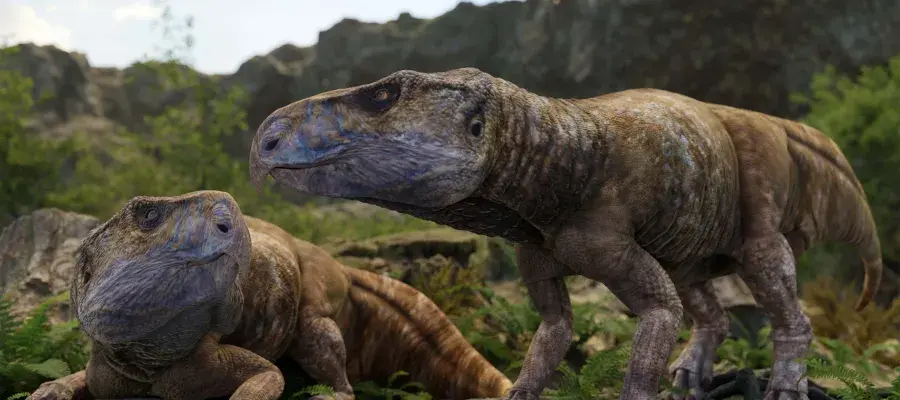
For decades, the map of prehistoric Europe showed a surprising gap. While the fossil records of North America and Asia are dominated by the iconic horned dinosaurs known as ceratopsians, European deposits seemed stubbornly silent on the matter. Aside from a few controversial fragments, paleontologists struggled to find definitive proof that these creatures ever roamed the continent. This absence created a significant evolutionary puzzle: if the earliest ceratopsians evolved in Asia and later spread to North America, the most logical migration route would have been through Europe. Why were the fossils missing?
Recent breakthroughs in paleontology, spearheaded by researchers from the University of Edinburgh, have finally begun to solve this mystery. By re-examining existing fossil collections and applying advanced analytical techniques, scientists have confirmed the presence of horned dinosaurs in the UK and continental Europe during the Cretaceous period. This research not only fills a major gap in our understanding of dinosaur migration but also highlights how easily these ancient creatures can be misidentified, even by experts.
Resolving the Ajkaceratops Controversy
The key to unlocking this European puzzle lay in Hungary. A fossil first described in 2010, named Ajkaceratops kozmai, had been a source of intense debate within the paleontological community. Its fragmented skull bones were unusual, leading some experts to classify it as a ceratopsian, while others argued it was more closely related to the plant-eating Iguanodon. The specimen was too incomplete to settle the argument definitively.
The turning point came with the discovery of additional Ajkaceratops fossil material. A research team, led by palaeontologists from the Natural History Museum, was able to perform a more detailed analysis on this newly found material. The results were conclusive: the dinosaur was indeed a ceratopsian. This confirmation provides the first solid evidence that horned dinosaurs lived in Europe around 84 million years ago, a time when the continent was not a single landmass but a series of large islands.
The Problem of Misidentification
Why did it take so long to find these dinosaurs? The answer lies in convergent evolution and the nature of the fossil record. As Professor Susannah Maidment, lead author of the study from the Natural History Museum, explains, “While Iguanodon and Triceratops look very different, the groups they are part of both evolved from a common ancestor.”
This shared ancestry, combined with similar lifestyles, led to the independent evolution of key traits. Both groups developed four-legged stances, complex chewing mechanisms, and large body sizes. Consequently, isolated teeth or limb bones from a ceratopsian could be remarkably similar to those of a rhabdodontid or an iguanodontian. Without a well-preserved skull, it was incredibly difficult to tell them apart. Professor Steve Brusatte of the University of Edinburgh noted that these European horned dinosaurs were “hiding in plain sight,” having been misidentified for decades as other types of dinosaurs.
Reclassifying Europe’s Dinosaur Families
The implications of this research extend beyond just one Hungarian fossil. The team’s analysis of the Ajkaceratops material prompted a wider review of other European dinosaurs. They discovered that a family of dinosaurs previously known as rhabdodontids, which were thought to be unique to Europe, were also ceratopsians. This is a monumental shift in classification, effectively rewriting the textbooks on European dinosaur fauna.
This reclassification helps to solve the evolutionary puzzle of ceratopsian migration. The presence of these dinosaurs in Europe provides a clear stepping-stone for their journey from Asia to North America. It suggests that these animals were more widespread and adaptable than previously thought, capable of colonizing the fragmented island landscapes of the Late Cretaceous.
The Importance of Museum Collections
This discovery underscores the critical role that museum collections play in advancing our understanding of natural history. The new evidence wasn’t necessarily found in a remote dig site in a far-flung corner of the world; it was often found by taking a fresh look at specimens that have been sitting in museum drawers for years. As analytical methods improve and our knowledge of evolutionary relationships deepens, these existing collections become invaluable resources for new discoveries.
Researchers are now calling for a systematic re-evaluation of other controversial or poorly preserved fossils from the UK and Europe. It is highly probable that more “hidden” ceratopsians are waiting to be identified within these collections, further fleshing out our picture of the Cretaceous period ecosystem.
What This Means for Dinosaur Research
The confirmation of horned dinosaurs in Europe is more than just a new entry on a species list. It fundamentally changes our understanding of dinosaur biogeography and evolution. It demonstrates that the University of Edinburgh and other institutions are at the forefront of using modern science to solve long-standing historical puzzles.
For students and aspiring paleontologists, this research offers a powerful lesson: science is an iterative process. Theories are constantly tested and refined as new evidence emerges. The dinosaurs of Europe were not a mystery because they didn’t exist, but because we didn’t yet have the tools or perspective to see them for what they were. This study is a testament to the persistence and ingenuity of the researchers dedicated to uncovering the deep history of our planet.
The findings, published in the prestigious journal Nature, mark a significant milestone in paleontological dinosaur research and promise to inspire a new wave of investigation into the prehistoric life of the UK and Europe.