
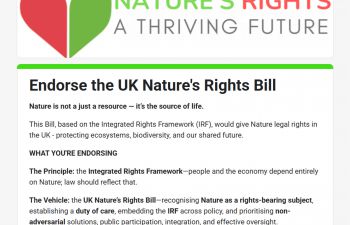
Why the Nature’s Rights Bill Matters for UK Environmental Law
The UK’s legal landscape has recently been reshaped by the introduction of the Nature’s Rights Bill, a progressive piece of legislation that seeks to grant legal personhood to ecosystems. This move reflects an evolving view of our relationship with nature: not only as a resource but as a rights‑bearing entity. For legal scholars, practitioners, and environmental organisations, understanding this shift is essential. It represents a new framework that could influence future litigation, property rights, and public policy across the country.
Dr Joanna Smallwood: A Catalyst for Change
Associate Professor of Law at the University of Sussex, Dr Joanna Smallwood has built her career on the convergence of environmental science and law. Her research on Rights of Nature has placed her at the forefront of the policy debate, and she was invited to testify in Parliament on 23 October as part of the bill’s launch. During the session, she highlighted how the Integrated Rights Framework can embed environmental limits into the legal system while balancing human and economic interests.
Dr Smallwood’s prominence stems from two key factors:
- Her academic contributions to the core working group that drafted the bill, led by Nature’s Rights founder Mumta Ito.
- Her ability to mobilise public support—proof of which can be seen in the online petition that currently gathers hundreds of signatures from businesses, NGOs and individuals.
Her involvement demonstrates how scholarship can translate into legislative impact, offering a roadmap for other researchers who wish to influence environmental policy.
How the Integrated Rights Framework Works
The bill’s core innovation is the Integrated Rights Framework (IRF). Unlike traditional environmental statutes that impose obligations on polluters, the IRF recognises natural entities—rivers, forests, wetlands—as legal subjects. This gives them custodians and a legal voice, enabling:
- Rights to self‑regulation of use and protection.
- Claims of damages when ecological integrity is compromised.
- Partnerships with human stakeholders that respect ecological limits.
For legal practitioners, this means new avenues for representation. A company that discharges waste into a protected river can be held civilly liable by a trust representing that river, thereby creating a novel basis for restitution.
Implications for Environmental Law Practitioners
- Litigation Strategy: Develop case law that leverages the river’s legal personhood as a plaintiff.
- Advisory Services: Educate clients on compliance with the duty of care now imposed by the IRF.
- Craft environmental impact assessments that incorporate rights‑bearing considerations.
Bottom‑Up Initiatives: River Ouse and Rights of Trees
While the National Inquiry represents a top‑down approach, Sussex is also leading practical, local implementations. The River Ouse became the first UK river to formalise a rights charter with the local council in 2023, followed by a 2025 river charter that outlines rights over water abstraction, conservation, and development.
Dr Smallwood’s Environmental Justice Law Clinic has orchestrated workshops with stakeholders—including developers, conservation bodies, and community groups—aimed at harmonising the River Ouse Charter’s provisions with existing planning frameworks. The workshops yielded tangible outcomes: agreements on water use limits during droughts and proposed monitoring mechanisms.
Rights of Trees: A First in UK Law
Parallel to river rights, a tree in Rother District has been acknowledged as a rights‑bearing entity. This marks a milestone for biodiversity UK, opening the door for future wildlife and forest protection litigations. Dr Smallwood’s team is preparing “The Rights of Trees, Woodlands and Forests Toolkit” for 2024, which will guide legal teams on drafting protective covenants and negotiating conservation easements.
Practical Steps for Stakeholders
For policy makers, the key is integrating IRF aligns with the UK’s commitment to the post‑2020 Biodiversity Framework. It offers a legal mechanism to enforce commitments to biodiversity targets.
Environmental NGOs can:
- Advocate for adoption of local charters in other rivers and forest areas.
- Leverage the legal personhood model to hold developers accountable.
- Engage in public campaigns that evidence the need for broader community support—similar to the online petition Dr Smallwood promotes.
Educational institutions can use the Sussex Law Clinic’s model as a teaching tool, offering students real‑world exposure to rights‑based litigation and community engagement.
Actionable Advice for Legal Professionals
1. Assess Existing Impact Assessments: Re‑review all current projects to identify any natural entities that may now qualify as legal persons under the IRF. Update compliance documents accordingly.
2. Build a Rights‑Bearing Advocacy Network: Connect with local environmental groups to co‑draft petitions and support initiatives that pay attention to rights of nature.
3. Leverage the Toolkit: Once the Rights of Trees Toolkit is released, incorporate its templates into client offerings that involve forestry, heritage landscapes, or conservation land.
4. Attend Parliamentary Briefings: Following UK environmental legislation, continuous engagement with lawmakers ensures that your firm stays ahead of regulatory shifts.
Next Steps for Applicants and Students
Students who are interested in environmental law should consider applying to the Environmental Justice Law Clinic or similar programmes. These clinics provide hands‑on experience in drafting, negotiation, and litigation in the nascent field of Rights of Nature.
To explore current opportunities, visit the University of Sussex Law School website and take advantage of the available courses that focus on environmental and natural resources law.
Conclusion – Turning Knowledge into Impact
The Nature’s Rights Bill represents a transformative development for UK environmental law. With the national framework gaining traction and local initiatives proving feasibility, there is a measurable shift from environmental protection as a reactionary measure to proactive rights‑based engagement. Dr Smallwood’s dual focus—legislative advocacy and grassroots implementation—illustrates a comprehensive approach that others can emulate.
Legal professionals, civil society actors, and policy makers all stand to benefit from understanding and adopting the Integrated Rights Framework as a tool for sustainable development and biodiversity preservation.
For those wishing to stay ahead of the curve, consider enrolling in a specialised environmental law program, or following the latest updates at Sussex Research. Together, we can shape a legal environment that respects the rights of nature and secures a healthier planet for future generations.
Call to Action:
- Explore the latest research on Rights of Nature and legislative developments.
- Submit your application to the University of Sussex Law School today and join a community dedicated to transforming environmental policy.
- Schedule a free consultation with Sussex’s Environmental Justice Law Clinic to discover how your next project can align with the Integrated Rights Framework.