
Master Heat Acclimation for the FIFA World Cup 2026 with Loughborough University UK Sports Training
As the FIFA World Cup 2026 approaches, hosted across the United States, Canada, and Mexico, elite athletes and officials face a formidable opponent beyond the opposing team: extreme heat. With temperatures forecasted to exceed 30°C in many tournament locations, physical preparation must evolve beyond standard fitness routines. Match officials, who must cover up to 12 kilometers per game while making split-second decisions, are particularly vulnerable to heat-induced fatigue. To combat this, England match official Stuart Burt partnered with Loughborough University UK to undertake a rigorous heat acclimation protocol. This article examines the science behind this sports training methodology, the specific physiological adaptations required for the FIFA World Cup 2026, and how Loughborough University continues to lead the field in elite performance preparation.
The Physiological Demands of the FIFA World Cup 2026
Competing in North America during the summer presents specific environmental challenges. High ambient temperatures coupled with significant humidity drastically alter the body’s thermoregulatory mechanisms. When exercising in these conditions, the body must divert blood flow away from the working muscles to the skin to facilitate heat dissipation through sweating. This cardiovascular strain increases heart rate and reduces the volume of oxygen-rich blood reaching the muscles, accelerating the onset of fatigue.
For a FIFA match official, physical fatigue directly correlates with cognitive decline. As core body temperature rises, reaction times slow, and spatial awareness diminishes. In a high-stakes tournament like the FIFA World Cup 2026, a delayed decision by mere milliseconds can alter the outcome of a match. Therefore, mitigating these physiological stressors through targeted sports training is not merely an advantage; it is an absolute necessity. Proactively preparing the body to handle extreme heat ensures that an official can maintain positional accuracy and decision-making clarity for the full 90-plus minutes.
Schedule a free consultation to learn more about our sports science programs and how they apply to elite athletic performance.
The Science of Heat Acclimation in Modern Sports Training
Heat acclimation is the process of repeatedly exposing the body to heat stress to induce a series of physiological adaptations that improve exercise capacity and reduce the risk of heat illness. Unlike general aerobic fitness, which improves cardiovascular efficiency in temperate conditions, heat acclimation specifically targets the body’s cooling systems. This type of specialized sports training typically requires consistent exposure over a short, intensive period—usually 7 to 14 days.
The primary goal is to teach the body to sweat earlier, sweat more profusely, and produce a more dilute sweat (lower electrolyte concentration). These adaptations lower the core body temperature threshold at which sweating begins, effectively expanding the body’s thermal buffer. By reducing the physiological cost of cooling itself, the body preserves cardiovascular capacity for physical exertion. Facilities dedicated to sports training, like the physiology department at Loughborough University UK, utilize specialized environmental chambers to precisely control temperature and humidity, ensuring athletes and officials can safely achieve these adaptations before traveling to hostile climates.
Explore our related articles for further reading on environmental physiology and athletic performance.
Inside the Loughborough University UK Heat Chamber
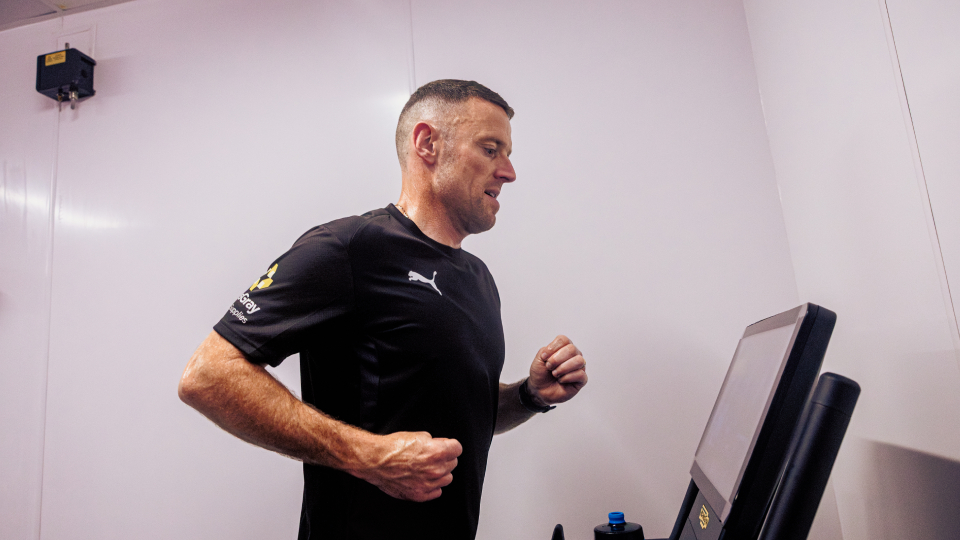
Stuart Burt, an official with over 500 Premier League matches and experience in UEFA EURO 2020, UEFA EURO 2024, the FIFA Club World Cup 2025, and the 2022 World Cup in Qatar, understands the necessity of marginal gains. To prepare for the FIFA World Cup 2026, Burt completed a concentrated block of 10 heat acclimation sessions over three weeks at Loughborough University.
Working closely with Hannah Bashford, a Performance Physiologist at Loughborough Sport, Burt’s protocol was carefully monitored to track specific physiological markers. The sports training sessions took place in an environmental chamber designed to replicate the expected conditions in Miami and other North American host cities. By systematically increasing the duration and intensity of the exercise within the chamber, Burt’s body was forced to adapt to the extreme thermal load.
Measuring Core Temperature and Cardiovascular Efficiency
One of the primary metrics monitored during Burt’s heat acclimation was tympanic temperature, which serves as a reliable proxy for core body temperature. As the sessions progressed, Bashford and her team observed a distinct reduction in Burt’s core temperature during fixed workloads. This indicates that his body became significantly more efficient at dissipating heat.
Concurrently, his heart rate responses improved. Under identical physical exertion in the heat, Burt’s heart rate was markedly lower post-acclimation. This reduction in cardiovascular strain means that during a match at the FIFA World Cup 2026, Burt will have a greater cardiac reserve, allowing him to sustain high-intensity running without prematurely exhausting his aerobic system. Lower perceived exertion also means he can focus his mental energy entirely on the flow of the game rather than the discomfort of the environment.
Enhancing Sweat Rate and Hydration Strategies
Another critical adaptation observed at Loughborough University UK was an increase in Burt’s sweat rate. While excessive sweating can sometimes be perceived negatively, a higher sweat rate in a heat-acclimated individual is a sign of an optimized thermoregulatory system. The body is actively cooling itself more effectively.
However, an increased sweat rate necessitates a robust hydration strategy. During the sports training block, the physiology team closely monitored Burt’s fluid intake to ensure it matched his increased sweat output. This matching process is vital to prevent significant drops in body weight during exercise, which can lead to dehydration, impaired cognition, and heat stroke. By practicing these hydration strategies in the controlled environment of the Loughborough heat chamber, Burt has established a precise fluid replacement protocol that he will execute on the pitch during the FIFA World Cup 2026.
Submit your application today to study at a world-leading sports institution and learn from the experts who train elite officials.
The Role of Loughborough University in Elite Sports Science
The success of Burt’s heat acclimation is a direct reflection of Loughborough University’s standing in the global sports science community. Loughborough University UK has been ranked as the best university in the world for sports-related subjects in the 2026 QS World University Rankings—marking the tenth consecutive year it has held this top position. This sustained excellence is built upon a foundation of cutting-edge research, state-of-the-art facilities, and direct partnerships with elite sporting bodies.
The university’s physiology department does not merely operate in an academic vacuum; it actively translates its research into practical, applied sports training interventions for Olympic athletes, professional footballers, and international match officials. The environmental chambers used for heat acclimation are the same tools utilized in pioneering research on thermoregulation, hydration, and performance degradation. Students and professionals who engage with Loughborough’s programs are learning methodologies that are actively shaping the outcomes of the FIFA World Cup 2026 and other major global sporting events.
Have questions about our physiology services or research facilities? Write to us!
Implementing Heat Acclimation in Your Own Sports Training
While not everyone has access to an elite environmental chamber at Loughborough University UK, the fundamental principles of heat acclimation can be applied to amateur and semi-professional sports training. If you are preparing for a hot-weather competition, consider the following actionable steps:
Gradual Exposure: Begin exercising in the heat for short durations (20 to 30 minutes) at a low intensity. Gradually increase the duration and intensity over 10 to 14 days. Avoid high-intensity interval training during the initial adaptation phase, as the cardiovascular strain will be too great.
Monitor Perceived Exertion: Pay close attention to how hard the exercise feels. Like Stuart Burt’s experience at Loughborough, your perceived exertion should decrease over time for the same workload. If it does not, you may need to adjust your acclimation protocol or review your hydration status.
Optimize Hydration: Weigh yourself before and after exercise in the heat. The goal is to minimize body weight loss (which represents fluid loss). Consume electrolyte-rich fluids to replace the sodium and potassium lost through increased sweating.
Maintain the Adaptation: Heat acclimation is relatively transient. The physiological adaptations can begin to fade within a few days of returning to a temperate climate. If you acclimate in the UK but travel to a hot climate a week later, you may lose some benefits. Time your sports training block so that your final heat sessions occur as close to your competition date as logistically possible.
Share your experiences with heat training in the comments below.
Conclusion
Prepare thoroughly for extreme environmental conditions to maintain peak performance. The collaboration between Stuart Burt and Loughborough University UK highlights the critical role that structured heat acclimation plays in modern sports training. By systematically reducing core body temperature, lowering heart rate, and optimizing sweat efficiency, elite officials can neutralize the physiological threats posed by the FIFA World Cup 2026. As environmental extremes become more common in global sports, the applied science of thermoregulation will remain a cornerstone of athletic preparation, ensuring that physical conditioning never limits tactical execution.