
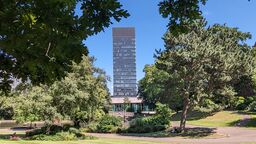
When observing the skyline of Sheffield, one structure consistently dominates the view: a 78-metre-tall glass and concrete tower that has defined the city’s architectural identity for generations. The University of Sheffield Arts Tower marks its 60th year in 2026, standing not just as a building, but as a historical record of post-war academic ambition and modernist design. For six decades, this Grade II* listed UK landmark has served as the academic home for thousands of Sheffield students, housing lecture theatres, design studios, and one of the most unusual lift systems in the world.
Examining the Origins of Sheffield’s Tallest Academic Structure
The story of the Arts Tower begins in 1953, when university administrators first envisioned a dedicated arts building to replace a scattered collection of older facilities. Initially, the plans did not call for a towering high-rise. However, as the university’s needs grew and the architectural possibilities of post-war modernism took hold, the design evolved dramatically. According to historical accounts from academics involved in the project, the building’s height increased continuously during planning meetings, with roughly two storeys added at every review until the final 19-storey design was agreed upon.
Construction required a robust foundation. The tower stands on solid rock located approximately 30 feet below the surface of Tower Court. Building this monumental structure took nearly four years of rigorous engineering and labor. When it finally opened its doors on 23 June 1966, the Arts Tower instantly became the tallest academic building in Europe, a title it holds domestically to this day as the tallest academic building in the UK.
The architectural firm Gollins, Melvin Ward and Partners designed the tower as a “cube of steel, glass, and concrete.” This design reflected the optimistic, forward-looking ethos of the 1960s, providing a stark but beautiful contrast to the older, red-brick Victorian buildings nearby. Explore our related articles for further reading on how post-war architecture reshaped British university campuses.
Why the Paternoster Lift Captivates Sheffield Students and Global Audiences
No discussion of the Arts Tower is complete without mentioning its most famous mechanical feature: the paternoster lift. Recognized by Guinness World Records as the world’s tallest and largest paternoster, this system consists of 38 open, two-person cars that operate on a continuous loop. Unlike traditional elevators that stop and wait for passengers, paternoster cars move constantly. Passengers must step into the moving cabins at the bottom or top of the loop and step out at their desired floor.
The university originally installed the paternoster to move large numbers of students and staff between floors efficiently. Because it does not stop, it makes short journeys significantly faster than conventional lifts. However, the system has also become a cultural phenomenon. Riding the paternoster is considered a rite of passage for Sheffield students. In recent years, videos of the unusual lift have gone viral on social media, attracting millions of views from architecture enthusiasts and curious viewers worldwide.
The lift has also generated its share of local legends over the past 60 years. One of the most notable early stories involves George Porter, a Professor of Physical Chemistry at the university who later won the 1967 Nobel Prize in Chemistry. Porter recalled attending a tea party on the 13th floor with his wife when the paternoster unexpectedly stopped, leaving them stranded at neck height to the floor. Unwilling to let the occasion fail, the Vice-Chancellor at the time simply joined them from a higher level and served tea through the open lift shaft while they waited for the mechanism to restart.
Share your experiences in the comments below if you have ever navigated the paternoster lift during your time at the university.
The Mechanics and Safety of Continuous Lifts
While paternoster lifts seem daunting to modern eyes, they operate on a highly reliable chain-and-pulley system. The cars are attached to two massive continuous chains that loop around sprockets at the top and bottom of the shaft. When a car reaches the top or bottom, it moves horizontally over the top or bottom wheel before descending or ascending the opposite side of the shaft. Because of their continuous movement and open-door design, many modern building codes prohibit the construction of new paternosters, making the Arts Tower’s system a rare and carefully preserved piece of engineering history.
Academic and Professional Life Inside the Arts Tower
Sixty years after its opening, the Arts Tower remains a highly active center for university life. It is not a museum piece, but a functioning, bustling workspace. The upper floors house the School of Architecture and Landscape Architecture. Placing the architecture school at the top of the building was a deliberate choice made during the original planning stages. The designers wanted students and staff to look out across the city and directly observe Sheffield’s post-war urban redevelopment taking shape in real-time. Today, those upper floors still offer unparalleled views, alongside modern studios, teaching spaces, and exhibition areas where students display their work.
The lower and middle floors have recently seen a significant transition. As part of the university’s strategy to use its estate more efficiently, more than 850 professional services staff have moved into the tower. This consolidation has brought a new energy to the building, blending administrative operations with academic creativity under one roof.
At the basement level, the university recently integrated another piece of Sheffield culture into the tower. John’s Van, a local café favorite among generations of Sheffield students, opened a new location in the building. This addition provides a vital social space, giving students and staff a place to meet, collaborate, and relax without leaving the tower. Submit your application today to potentially study and create within this unique academic environment.
Architectural Significance and Grade II* Listed Status
The Arts Tower’s architectural importance was formally recognized when it received its Grade II* listing, a status reserved for buildings of exceptional interest. The design is a prime example of post-war modernist architecture in the UK. The facade features a strict grid of glass and concrete, emphasizing the structural honesty and functional design principles that defined the era.
When HM Queen Elizabeth The Queen Mother officially opened the building in June 1966, she famously described it as Sheffield’s “tower of light and learning.” This name has endured, capturing the way the glass facade catches the sunlight and the building’s primary purpose as an educational hub.
The building’s history also includes a few structural learning curves. The original design included shallow pools and fountains at the main entrance. However, the tower’s immense height created a severe wind tunnel effect at street level. This wind regularly blew the fountain water over students and staff using the main entrance, forcing the university to cover the pools over. During a recent 2026 refurbishment of the entrance steps and tile flooring, the university paid homage to this history by reintroducing the outline of the original fountains using brick setts.
The Future Campus Plan: Preserving the Arts Tower for Decades to Come
Maintaining a 60-year-old, 19-storey concrete tower requires continuous investment and strategic planning. The university executed a major refurbishment in the late 2000s to modernize the internal environment, improve energy efficiency, and secure the building’s structural future. A significant portion of this work focused on protecting and upgrading the historic paternoster lift, ensuring it meets modern safety standards while retaining its original mechanical character.
Looking forward, the Arts Tower plays a central role in the University of Sheffield’s Future Campus Plan. This strategic initiative aims to make the university’s estate more vibrant, sustainable, and suited to modern academic needs. The plan focuses on creating a compact, high-quality, and well-connected campus by maximizing the use of existing buildings rather than constantly expanding outward. Because of its sheer size, central location, and recent integration of hundreds of staff members, the Arts Tower is a primary example of how the university is optimizing its space.
The goal is to balance historical preservation with functional modernization. By upgrading facilities, adding social spaces like the John’s Van café, and maintaining the architectural integrity of the modernist design, the university ensures the Arts Tower will remain a relevant and active UK landmark for the next 60 years.
Schedule a free consultation to learn more about the facilities and academic programs housed within the University of Sheffield. Have questions? Write to us! We are happy to provide additional details on campus life and the history of our iconic buildings.