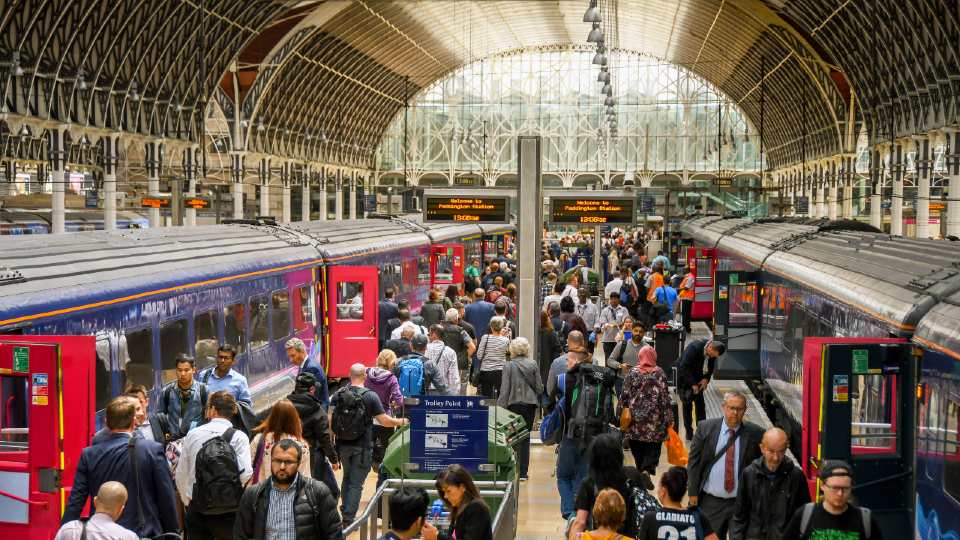
Overcrowding on UK railways remains a persistent challenge for both transit operators and daily commuters. As passenger demand fluctuates and legacy infrastructure struggles to keep pace, finding accurate, real-time solutions to manage capacity is critical. Addressing this issue, researchers at Loughborough University have partnered with rail technology company TrainFX to develop a sophisticated AI-powered monitoring system designed to facilitate overcrowding reduction and significantly improve the overall passenger experience.
This collaborative effort represents a practical application of computer vision and artificial intelligence in a public transport setting. By focusing on real-time data processing and privacy-conscious hardware, the project aims to provide rail operators with the precise metrics needed to manage carriage capacity effectively. Explore our related articles for further reading on transport technology innovations.
Understanding the Capacity Crisis on UK Railways
The UK rail network is one of the busiest and most heavily utilized in Europe. While recent years have seen shifts in commuting patterns, peak-hour services in major urban centers continue to operate at or beyond maximum capacity. The core problem facing operators is not necessarily a lack of available space across the entire train, but rather an uneven distribution of passengers.
Historically, operators have relied on ticket sales data, manual counts, or weight-based sensors to estimate passenger loads. However, these methods suffer from significant delays and inaccuracies. Ticket data does not account for passengers who miss trains or change carriages, while weight sensors can be triggered by luggage or uneven loading. Consequently, passengers often board the first available carriage, leading to severe congestion in specific areas while middle or rear carriages remain partially empty. This imbalance directly degrades the passenger experience, increases boarding times at stations, and creates safety concerns during rush hour.
How the AI-Powered Monitoring System Operates
To resolve the inaccuracies of legacy counting methods, the Loughborough University research team developed a system that leverages advanced depth-sensing cameras paired with onboard artificial intelligence. Unlike standard surveillance cameras that capture high-resolution video feeds, this AI-powered monitoring system captures only spatial depth information.
When a passenger walks past the sensor, the camera creates a three-dimensional silhouette based on distance and volume, entirely ignoring visual details like clothing, facial features, or color. This depth data is then instantly processed by an AI algorithm located directly on the train. The system analyzes the silhouette to determine whether the object is a person rather than luggage or a bicycle, and tracks their movement into or out of the carriage.
Privacy-Conscious Depth Imaging Technology
Public acceptance of monitoring technology in shared spaces hinges heavily on privacy. Standard CCTV networks often face pushback from privacy advocates and the general public due to the potential for facial recognition and behavioral tracking. The Loughborough University system circumvents these concerns entirely through its use of depth-only imaging.
Because the sensors do not record visual light or standard video footage, it is mathematically impossible to identify an individual from the data collected. The AI model only registers a generic, anonymous shape. This approach aligns with modern data protection regulations and ensures that the technology serves the singular purpose of capacity management without compromising individual privacy rights.
Integrating Real-Time Data for Overcrowding Reduction
The true value of this AI-powered monitoring system lies in its integration with existing train infrastructure. The technology has been embedded directly into TrainFX’s Smart Passenger Information System, known as Smart-PIS. A critical design choice was to process the data onboard the train rather than sending it to a remote cloud server.
Trains frequently pass through tunnels, deep cuttings, and rural areas where network connectivity is unreliable or nonexistent. By utilizing edge computing—processing the AI algorithms locally on the train—the system guarantees a continuous stream of accurate occupancy data regardless of the network status. This live data is then transmitted to central control rooms and station platforms whenever a connection is available.
For rail operators, this continuous flow of precise data enables active overcrowding reduction strategies. Station staff can be alerted to heavily loaded carriages before the train arrives at the platform, allowing them to direct waiting passengers toward less crowded sections via public address systems or digital displays. Over time, this granular data also informs long-term service planning, helping operators adjust train schedules, add carriages to specific routes, or modify seating layouts based on empirical demand rather than estimates.
Schedule a free consultation to learn more about implementing AI solutions in public transport.
Improving the Passenger Experience Through Better Information
While the primary beneficiaries of this technology are the operators managing the network, the ultimate goal is to improve the passenger experience. Overcrowding is consistently cited as one of the top frustrations for rail users. The stress of navigating a packed platform, only to squeeze into an already full carriage, significantly detracts from the perceived quality of the service.
In the future, the data generated by the AI-powered monitoring system could be shared directly with passengers via mobile applications or station displays. If a commuter knows that Carriage B is at 80% capacity while Carriage D is only at 30%, they can make informed decisions about where to stand on the platform and which carriage to board. This targeted distribution of passengers reduces dwell times at stations, minimizes the physical discomfort of crowded commutes, and creates a more predictable, pleasant journey.
Share your experiences with UK railway overcrowding in the comments below.
Testing and Real-World Deployment on UK Railways
Before deploying any new technology on a live railway network, rigorous testing is required to ensure safety and reliability. The multi-camera prototype developed by Loughborough University and TrainFX has already undergone extensive evaluation in a simulated rail environment. During these tests, the system successfully monitored passenger movement around train doors and internal carriage spaces, maintaining high levels of accuracy even when simulating busy rush-hour scenarios and low-light conditions.
Following the success of the simulated trials, the prototype is now prepared for live testing. TrainFX is currently working alongside established train operators to coordinate the next stage of deployment, which will involve installing the system on operational trains within the UK rail network. These live trials will be the ultimate test of the system’s robustness, evaluating how the AI handles real-world variables such as sudden stops, complex passenger movements, and varying environmental conditions.
The Role of Academic and Industry Collaboration
The development of this AI-powered monitoring system was funded by UK Research and Innovation (UKRI) through a Knowledge Transfer Partnership (KTP). This government-backed initiative is designed to facilitate the sharing of academic expertise with commercial enterprises, driving innovation that might otherwise remain confined to a laboratory setting.
The partnership between Loughborough University and TrainFX demonstrates the practical benefits of this model. The academic team, led by Professor Baihua Li and including Professor Qinggang Meng, Dr Mohamad Saada, and Dr Haibin Cai, provided the foundational AI and computer vision research. Day-to-day development was led by Dr Sajanraj T. Dharmarajan, Syed Muneeb Ahmed, and Dr Yixiao Zhang. TrainFX, represented by Managing Director Hansoon Han and Assistant General Manager Dr Qun Zhu, provided the commercial focus, industry knowledge, and hardware integration capabilities necessary to turn academic theory into a viable product.
The success of this collaboration was recently recognized when the project won the AI Tech Innovation of the Year category at the Made in the UK Midlands Awards 2026. This accolade highlights the regional strength of the UK’s technology sector and the tangible impact of university-industry partnerships on national infrastructure challenges.
Future Implications for UK Railways
As the UK rail network continues to modernize, the integration of intelligent monitoring systems will likely become standard practice. The technology developed by Loughborough University and TrainFX provides a scalable blueprint for overcrowding reduction. If live trials prove successful, rail operators could roll out the system across entire fleets, creating a comprehensive, real-time map of passenger density across the national network.
Beyond immediate capacity management, this data holds significant value for future infrastructure investment. Planners can use historical and real-time occupancy data to justify the cost of new rolling stock, identify bottlenecks in station design, and optimize timetables to better match actual passenger demand. By shifting from reactive crowd control to proactive capacity management, the UK rail industry can build a more efficient, reliable, and passenger-centric network.