Examine Edward Said’s Postcolonial Theory at the University of Kent
Understanding the complex mechanisms of power, representation, and resistance requires a rigorous engagement with history and literature. In the contemporary academic landscape of the UK, few frameworks offer as much analytical precision as postcolonial theory. At the center of this discipline stands Edward Said, a Palestinian-American intellectual whose work fundamentally altered how scholars approach the humanities. Recently, the University of Kent hosted a major symposium reflecting on Said’s intellectual legacy, demonstrating exactly why his theories remain essential tools for analyzing global inequalities.
The Enduring Relevance of Postcolonial Theory in the UK
Postcolonial theory is not merely an exercise in historical critique; it is an active methodology used to dismantle the enduring structures of empire. For students and researchers in the UK, engaging with this theory is particularly vital. The UK’s extensive imperial history means that its cultural, political, and legal institutions are deeply intertwined with the histories of the Global South. Edward Said’s foundational texts provide the vocabulary required to interrogate these overlapping histories.
Said argued that culture and imperialism are not separate entities but mutually reinforcing systems. By studying the humanities through this lens, scholars can identify how seemingly innocuous cultural artifacts—novels, academic texts, and political discourses—participated in and sustained imperial domination. This critical perspective is a cornerstone of modern humanities programs, equipping students to understand the world not as a series of isolated events, but as a network of intertwined histories.
Schedule a free consultation to learn more about our humanities programs.
Rediscovering the 1985 T.S. Eliot Lectures at Kent
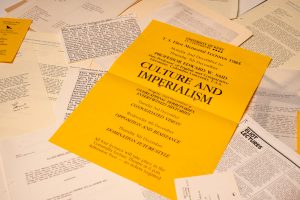
The recent symposium at the University of Kent was prompted by a remarkable archival discovery. In February 2025, Jessica Elias, a PhD candidate at Kent Law School, located a set of digital recordings in the Templeman Library archives. These recordings captured a series of lectures delivered by Edward Said in December 1985 as part of the T.S. Eliot Memorial Lectures.
During this visit to Kent, Said presented four two-hour lectures titled: Overlapping Territories, Intertwined Histories; Consolidated Vision; Opposition and Resistance; and Domination Futurestyle. At the time, these lectures represented a significant evolution in Said’s thinking, moving beyond his earlier focus on Orientalism to a broader analysis of how Western cultural production facilitated imperial expansion.
The Genesis of Culture and Imperialism
The content of these 1985 lectures at the University of Kent directly formed the foundation of Said’s 1993 seminal book, Culture and Imperialism. Listening to the recordings four decades later, the prescience of Said’s arguments is striking. He meticulously outlined how the novel, as a cultural form, was instrumental in establishing and maintaining imperial authority. He examined authors like Jane Austen and Joseph Conrad, demonstrating how their narratives normalized the expansion of British and European power.
The concept of “overlapping territories” is particularly relevant today. Said posited that the geographical and cultural boundaries drawn by empires were artificial and that the histories of the colonizer and the colonized are inextricably linked. For modern scholars, this concept provides a framework for understanding contemporary conflicts, migration patterns, and cultural exchanges without resorting to simplistic, binary narratives.
“Humanity at a Crossroads”: A 2026 Symposium
To honor the 40th anniversary of Said’s lectures and as part of the University of Kent’s 60th-anniversary celebrations, the institution hosted the “Humanity at a Crossroads” symposium in May 2026. This event brought together academics, students, and legal professionals from the UK, Ireland, Kashmir, Gaza, and Lebanon to reflect on the legacies of empire and the global significance of humanism.
A central feature of the symposium was the presence of Professor Wadie Edward Said, Edward Said’s son. A professor of law at the University of Colorado, Wadie Edward Sayid provided concluding remarks that bridged his father’s cultural and literary theories with contemporary international law. This connection highlighted a crucial aspect of postcolonial theory: its application extends beyond literature into the legal and political frameworks that govern international relations and human rights today.
Explore our related articles for further reading on cultural studies.
Cultivating Intellectual Courage in the Humanities
The decision to host Edward Said in 1985, and to center a major symposium around his rediscovered lectures in 2026, speaks to the University of Kent’s institutional identity. The university has a long-standing reputation as a sanctuary for critical thought. Over the decades, it has provided a platform for intellectuals who challenge dominant paradigms.
This tradition of intellectual courage is reflected in the caliber of thinkers associated with Kent. The university’s connection to Nobel laureates in Literature—such as Abdulrazak Gurnah, who served as a Professor of English and Postcolonial Literatures, and Kazuo Ishiguro—demonstrates a deep institutional commitment to the humanities. Furthermore, the presence of influential theorists like Julia Kristeva in the T.S. Eliot lecture series reinforces the idea that universities must function as spaces where difficult, necessary conversations occur, even amid global crises.
Submit your application today to join a community of critical thinkers.
Studying the Intersections of Culture, Law, and Politics
For prospective students considering a degree in the humanities, the trajectory of Edward Said’s work offers a compelling argument for interdisciplinary study. Said did not confine himself to English literature; he integrated politics, linguistics, history, and critical legal studies into his analysis. He effectively created a new discipline—postcolonial studies—by refusing to accept the traditional boundaries between academic fields.
Modern humanities programs in the UK are increasingly designed to foster this type of interdisciplinary thinking. Students are encouraged to analyze how legal frameworks are influenced by cultural narratives, and how political policies are justified through historical revisionism. By engaging with postcolonial theory, students learn to identify the underpinning connections between representations of culture and systems of oppression. This skill set is invaluable for careers in law, international relations, journalism, education, and public policy.
The University of Kent’s approach to these subjects emphasizes that studying the humanities is not an isolated academic pursuit. It is a rigorous training ground for analyzing the structures of power that shape everyday life. The rediscovery of Said’s lectures serves as a practical reminder that archival research and theoretical study have direct, urgent applications to contemporary global issues.
Have questions? Write to us!
The Responsibility of the Modern Intellectual
Edward Said famously defined the intellectual as an exiled figure, someone who speaks truth to power from the margins. The “Humanity at a Crossroads” symposium demonstrated that this definition remains highly relevant. In an era marked by war, displacement, and the erosion of international legal principles, the need for rigorous, independent critical thought is paramount.
Said’s work endures because it does more than help us understand the world; it challenges us to change it. He provided a methodology for dissecting the “consolidated visions” of empires and offered strategies for “opposition and resistance.” For students and academics engaging with the humanities today, the task is to carry this methodology forward. It requires the courage to ask difficult questions about history, to challenge established narratives, and to maintain a commitment to humanism even in the face of overwhelming systemic pressure.
The University of Kent’s commemoration of Edward Said’s 1985 lectures is a testament to the enduring power of the humanities. It proves that the theories developed decades ago retain their analytical power, providing the necessary tools to navigate the complex, intertwined histories of our present moment.
Share your experiences in the comments below.