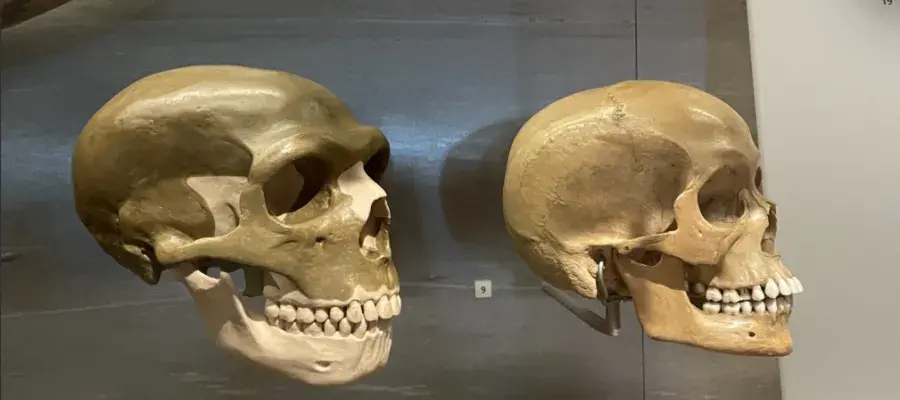
Researchers at the University of Edinburgh have uncovered a new link between non‑coding DNA—often called the dark genome—and the distinctive jaw shape of Neanderthals. By comparing specific genetic variants found only in Neanderthals with the modern human genome, the team showed that a regulatory element controlling the SOX9 gene was more active in the extinct hominin. This discovery provides a concrete example of how changes in DNA that do not directly encode proteins can influence large‑scale anatomical traits.
What is the Dark Genome?
For a long time the roughly 98 % of DNA that does not encode proteins was dismissed as “junk.” Recent advances in genomics have overturned that view. The dark genome hosts a variety of regulatory sequences—enhancers, silencers, insulators—that shape when, where, and how strongly a gene is expressed. Alterations in these regions can produce profound biological effects even though they leave the protein‑coding parts of the genome unchanged.
The study leveraged this growing understanding by focusing on an enhancer that modulates the expression of the SOX9 transcription factor, one of the key regulators of craniofacial development in mammals.
SOX9 and Facial Development
SOX9 plays a critical role in early embryonic cell populations known as neural crest progenitors. These cells migrate to the face and give rise to cartilage, bone, and connective tissue. Mutations that inactivate SOX9 cause severe craniofacial disorders, such as campomelic dysplasia, and reduction of its activity has been linked to Pierre Robin sequence—an underdeveloped lower jaw condition in humans.
Enhancer Switches and Jaw Morphology
The terminus of the enhancer in question is located in a region that does not encode a protein but is necessary for the activation of SOX9 in neural crest cells. Previous work on humans indicated that deletion of this enhancer leads to diminished SOX9 expression and a resulting under‑protruded mandible. The hypothesis was straightforward: if an enhancer is more active, it could drive higher expression of SOX9 during critical periods and cause the jaw to grow more robustly.
Comparing Neanderthal and Human Genomes
Genomic sequencing of Neanderthal fossils has revealed numerous variants within regulatory and coding regions. The Edinburgh team focused on three specific alleles found in Neanderthals that differed from the modern human consensus sequence in the enhancer region upstream of SOX9. The variants were then synthetically inserted into zebrafish models to assess their functional impact.
Why Zebrafish?
Zebrafish embryos are a well‑established system for studying vertebrate development because of their transparency and rapid growth. Moreover, the conservation of key developmental pathways—including SOX9—between fish and mammals means that changes in enhancer activity can be observed by measuring reporter gene expression in targeted cell types.
Reporter Assays Highlight Increased Activity
Using a luciferase reporter linked to the Neanderthal enhancer, researchers observed a two‑to‑threefold increase in transcriptional activity compared to the human sequence. Immunofluorescent staining of the embryos showed heightened reporter expression specifically in neural crest‑derived craniofacial progenitors, confirming that the Neanderthal version drives stronger gene activation during the window of jaw formation.
Implications for Neanderthal Morphology
Neanderthal fossils are characterized by a prognathic face—an outwardly protruding jaw—alongside a broader browridge and reduced nasal aperture. The heightened SOX9 activity resulting from the Neanderthal enhancer variants offers a plausible mechanistic explanation for the former trait. By sustaining higher levels of SOX9 during embryonic development, the cranial neural crest population may have produced a more robust mandible.
While morphology is the product of both genetic and environmental factors, this study shows that regulatory changes alone can account for significant anatomical differences between closely related species.
Broader Significance for Human Facial Variation
Studying the dark genome holds promise beyond palaeogenetic questions. Given the role of SOX9 in facial development, naturally occurring enhancer variants in modern humans could influence the diversity of jaw shape, nose size, and overall facial profile. In clinical genetics, mutations or polymorphisms in these regulatory regions may underlie seemingly isolated craniofacial anomalies without overt coding mutations.
Future population‑level studies could map enhancer polymorphisms to phenotypic measurements derived from 3D facial scans, providing a deeper understanding of the genetic architecture of human facial diversity.
Future Directions and Potential Applications
The authors plan to expand their work to examine additional enhancer variants that differ among human populations and archaic hominins. They also intend to investigate how these regulatory changes interact with hormonal signals and mechanical forces during bone remodeling.
From a translational standpoint, mapping the regulatory network governing facial development can guide the creation of gene‑therapy strategies for craniofacial syndromes. If a specific enhancer is known to increase SOX9 expression, synthetic elements could potentially be introduced to rescue under‑developed mandibles in affected patients.
Engaging with Edinburgh’s Genetics Community
Interested in the intersection of human evolution and developmental biology? The University of Edinburgh offers a range of research opportunities and graduate programmes focused on genetics. Whether you are a prospective student, a researcher looking to collaborate, or a professional wanting to deepen your expertise, the Institute of Genetics and Cancer provides cutting‑edge facilities and faculty expertise.
To learn more about our doctoral projects or to discuss potential collaborations, contact our faculty members through the institute’s online portal: Institute of Genetics and Cancer. If you are contemplating enrolling in an advanced genetics program, explore our MSc in Genetics track.
Conclusion
This research underscores that the dark genome is not a void but a dynamic landscape shaping phenotype. By elucidating how Neanderthal-specific enhancer variants modulated SOX9 activity, scientists have shed light on the evolutionary divergence of human faces. The study paves the way for further exploration of non‑coding DNA in both evolutionary biology and clinical genetics, bringing us closer to comprehending how subtle genetic switches sculpt the human body.
For a deeper dive into the experimental methods and full discussion, read the original article published in Development.
Want to explore genetics further?
Discover our research projects, enrol in graduate programmes, or reach out to our faculty for collaboration opportunities. Your next step in genetics research can begin right here at Edinburgh.